ACETAL BAR WEIGHT CALCULATOR
What is Toolerz Acetal Bar Weight Calculator?
Toolerz acetal bar weight calculator is a free online tool used to estimate the weight of a bar made from acetal resin, also known as polyoxymethylene (POM) or Delrin.
Using our tool we can calculate the weight of the acetal bars of various shapes like Square, Circular, Rectangular, etc.,
How to Use Toolerz Acetal Bar Weight Calculator
Here is the simple and step-by-step procedure to use our tool
Step 1: Visit the home page (www.toolerz.com) and search for "Acetal Bar Weight Calculator"
Step 2: Enter the input parameters like Shape, Length, Diameter, and Thickness of the bar.
Step 3: Hit the Calculate Button to get the weight of the bar
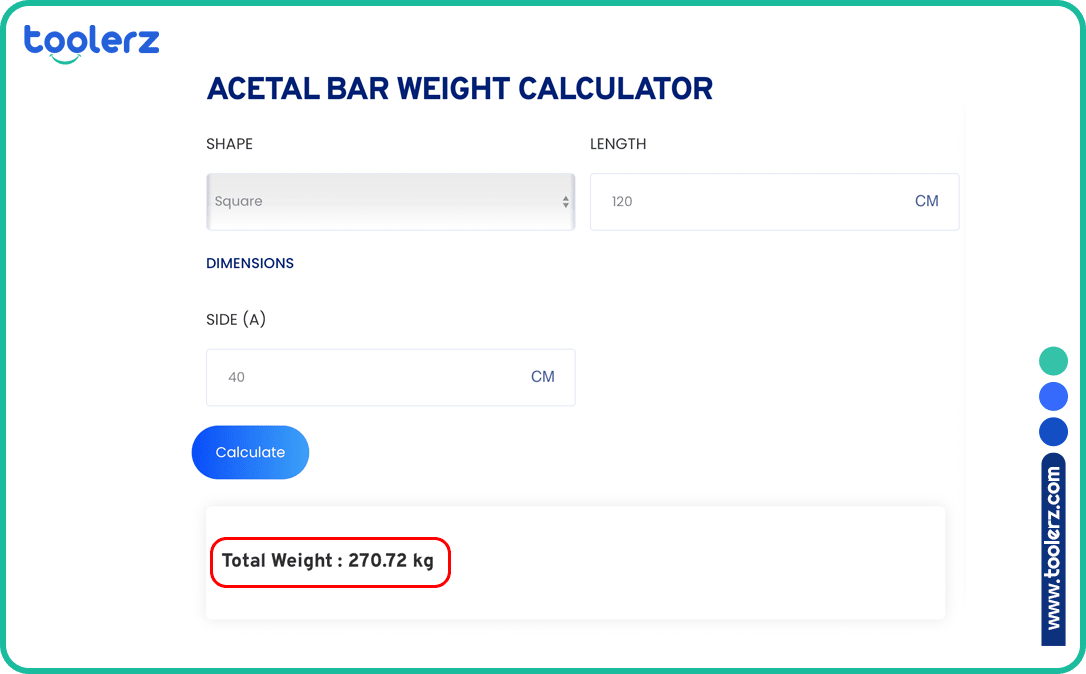
In industries like manufacturing & engineering, precision and accuracy play a important role. Understanding the weight of materials like acetal bars is essential for various applications. Our tool helps you calculate the exact weight of the acetal bars.
What is the density of Acetal?
Acetal, also known as polyoxymethylene (POM), is a strong and versatile engineering plastic commonly used in precision parts.
It is well-known for its high stiffness, low friction, and excellent dimensional stability. The density of acetal typically ranges from 1.41 to 1.43 grams per cubic centimeter (g/cm³). This value can slightly vary depending on the specific grade or formulation, such as homopolymer or copolymer types.
Understanding the density of acetal is important for applications that require strength without added weight.
Its relatively low density, compared to metals, makes it a great choice for automotive, industrial, and consumer products. Whether you're selecting materials for gears, bearings, or fasteners, knowing the density helps in calculating weight and ensuring the right fit for your project.
Benefits of our Tool:
Accuracy: Our calculator provides accurate weight calculations, eliminating the margin for error that often occurs with manual calculations.
Efficiency: By automating the calculation process, the tool saves valuable time and effort for users, enabling faster decision-making.
Accurate weight estimations help in optimizing material usage, reducing waste, and minimizing costs in manufacturing processes.
Versatility: Users can customize input parameters such as length, width, thickness, and density, catering to different needs and specifications.
Easy-to-Use: With a user-friendly interface and design, our calculator is accessible to users of all levels.
Need more material weight calculations? Try our Steel Sheets and Plates Calculator for accurate steel weight measurements.
Applications of Acetal Bar Weight Calculator
The Acetal Bar Weight Calculator is a valuable tool for those working with acetal bars, commonly used in manufacturing, engineering, and construction. Acetal, also known as POM (Polyoxymethylene), is a high-performance plastic known for its durability, low friction, and high mechanical strength.
The weight calculator helps professionals and manufacturers accurately determine the weight of acetal bars based on their dimensions and density, allowing for precise material estimation.
This tool is especially beneficial in industries like machining, automotive, and aerospace, where accurate weight calculations are essential for material sourcing, production planning, and cost management.
The calculator simplifies the process of determining material requirements, saving time and reducing waste. It also helps in optimizing shipping and transportation costs by calculating the exact weight of acetal bars needed for projects.
Overall, the acetal bar weight calculator ensures efficiency, accuracy, and cost-effectiveness in various applications.
Acetal Bar Weight Calculator Formula
The formula used by the Acetal Bar Weight Calculator to compute the weight of an acetal bar is:
Weight=Length×Width×Thickness×Density
Where:
Weight represents the weight of the acetal bar.
Length, Width, and Thickness are the dimensions of the acetal bar.
Density is the material density of the acetal bar.
How to Calculate Weight of Steel Bar?
Calculating the weight of a steel bar is simple if you know the formula.
The most common method uses the formula:
Weight (kg) = (D² × L) / 162, where D is the diameter of the bar in millimeters, and L is the length in meters.
This formula gives an accurate estimate of the weight of round steel bars.
How Much Does 1 Kg of Steel Weigh?
At first, the question “How much does 1 kg of steel weigh?” might seem confusing, but the answer is simple—1 kilogram of steel weighs exactly 1 kilogram.
However, what people usually mean is how much space or volume 1 kg of steel takes up, or how it compares to other materials in terms of density.
Steel is a dense material, with a standard density of around 7850 kg/m³. This means 1 kg of steel will occupy less volume than lighter materials like aluminum or plastic.
Understanding this is important in construction, manufacturing, and shipping, where both weight and volume matter.
So, while 1 kg of steel always weighs 1 kg, its physical size will be small due to its high density. This makes steel ideal for strong, compact structures.
Use steel weight calculators for accurate results in real-world applications.
Example:
Suppose we have an acetal bar with dimensions 50 cm (length) x 5 cm (width) x 2 cm (thickness) and a density of 1.41 g/cm³.
Using our tool, the weight of the acetal bar would be:
Weight=50 cm×5 cm×2 cm×1.41 g/cm³
Weight=705 g
Need more helpful tools? Check out our Gpa Calculator for quick and accurate academic score calculations.
Key Features of Acetal Bar Weight Calculator
The Acetal Bar Weight Calculator is an essential tool for anyone working with acetal bars in industries like manufacturing, construction, and engineering. It allows users to quickly determine the weight of acetal bars based on their dimensions, such as length, width, and thickness.
The key features include its ability to accommodate different shapes and sizes of bars, offering quick and accurate results. The calculator also takes into account the density of acetal material to ensure precise weight calculations.
Additionally, it helps in reducing material wastage by providing users with an exact weight estimate, aiding in proper inventory management. Its user-friendly interface and easy-to-understand output make it accessible for both beginners and professionals.
Whether you’re purchasing, manufacturing, or shipping acetal bars, this calculator simplifies your tasks and enhances accuracy in your operations.
FAQs
Q1: What is the density of acetal bar?
Ans: The density of acetal typically ranges around 1.41 g/cm³ or 1410 kg/m³.
Q2: Can I use the Toolerz calculator for both rectangular and round acetal bars?
Ans: Yes, our calculator supports weight calculations for both rectangular and round acetal bars.
Q3: How accurate is the Toolerz Acetal Bar Weight Calculator?
Ans: The accuracy of the calculation depends on the input values entered and the density. Our calculator provides highly accurate results based on the provided inputs.
Q4: Do I need to know the exact density of the acetal used?
Ans: Knowing the exact density of the specific acetal grade you are using will provide the most accurate weight calculation. However, using the typical density of 1.41 g/cm³ will give a good estimate.
Q5: Can I use the calculator for other materials?
Ans: While the calculator is designed for acetal, you can use it for other materials by inputting the appropriate density for the material.
Q6: Is the calculator accessible on mobile devices?
Ans: Yes, our acetal bar weight calculator is fully compatible with mobile devices, allowing you to perform calculations on the go.
Q7: How do I convert the weight from kilograms to pounds?
Ans: To convert the weight from kilograms to pounds, multiply the weight in kilograms by 2.20462.
Q8: Can I save or print the calculation results?
Ans: Yes, our calculator provides options to save or print the calculation results for future reference.
Q9: Why is it important to calculate the weight of acetal bars?
Ans: Calculating the weight is important for material selection, inventory management, cost estimation, and ensuring that components meet design specifications.
Q10: Are there any limitations to using the acetal bar weight calculator?
Ans: The calculator is highly versatile, but its accuracy depends on the precision of the input data. Ensure that you measure dimensions accurately and use the correct density value for the best results.
Q11: Can this calculator handle different units of measurement for dimensions and density?
Ans: Yes, our calculator has the option to input dimensions and density in various units, such as centimeters, meters, inches, grams, or kilograms.
Q12: Is this Acetal Bar Weight Calculator suitable to calculate the weight of the other materials?
Ans: No, this calculator is specifically designed for acetal bars, we cannot calculate the weight of the other metals as the density of the bar changes.
Q13: What is an Acetal Bar Weight Calculator?
Ans: An Acetal Bar Weight Calculator is an online tool that helps you calculate the weight of an acetal plastic bar based on its dimensions and density. It saves time and provides accurate results for manufacturing, shipping, and cost estimation.
Q14: How does the Acetal Bar Weight Calculator work?
Ans: The calculator requires inputs like diameter (for round bars) or width and thickness (for rectangular bars), along with the length of the bar. It then uses the density of acetal to estimate the total weight.
Q15: Is the Acetal-Bar Weight Calculator free to use?
Ans:Yes, most Acetal-Bar Weight Calculators available online are free. You don’t need to sign up or pay anything. Just enter the measurements, and you’ll get instant results https://toolerz.com/ .
Q16: Does the unit of measurement matter in the calculator?
Ans:Yes, it does. You should use the same unit throughout the input fields — for example, if you use centimeters for length, use centimeters for width/diameter too. Most calculators will show results in kilograms or grams.
Q17:Can I use this calculator for other plastic materials?
Ans:No, this calculator is designed specifically for acetal. If you’re working with other plastics like nylon, PVC, or PTFE, you should use a calculator made for those materials with the correct density values.
18. Can I use the calculator for different units like inches or millimeters?
Ans:Yes, good calculators give you the option to select your preferred units, whether in metric (mm, cm) or imperial (inches, feet).