EDD CALCULATOR
What is EDD Calculator?
Toolerz Estimated Due Date Calculator (EDD) is developed to estimate the expected delivery date based on the first day of the last menstrual period.
This tool helps the upcoming parents to calculate the estimated date of delivery so that they can plan the post-delivery activities.
How to Use EDD Calculator
This tool can be accessible to people from all over the world. Here are the simple steps to use our EDD calculator.
The first step is to enter the home page of our website i.e., www.toolerz.com and search for EDD Calculator in the search bar
Select the tool and go to the tool's page
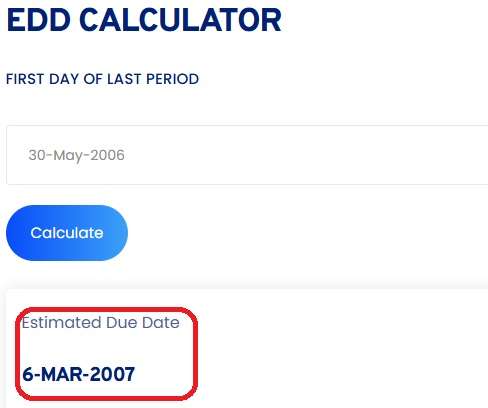
After entering the page, enter the First Day of Last Period to provide the due date.
After entering the details, simply hit the "Calculate" button.
Our tool will calculate the approximate due date of your pregnancy based on the given date.
Benefits of EDD Calculator
An EDD (Estimated Due Date) Calculator is a valuable tool for expectant mothers and healthcare providers. It helps predict the likely date of delivery based on the last menstrual period (LMP) or conception date.
One of its key benefits is early pregnancy planning, allowing parents to prepare emotionally, physically, and financially for the arrival of their baby.
It also assists doctors in scheduling prenatal appointments, ultrasounds, and important tests at the right stages of pregnancy. By knowing the estimated due date, mothers can monitor their baby’s growth and track progress week by week.
The EDD calculator is simple to use and provides quick results, making it an essential feature in many pregnancy tracking apps. It reduces guesswork and brings clarity during an important time.
Overall, the EDD calculator supports better healthcare, timely planning, and a more confident pregnancy journey for both parents and doctors.
Determining the Estimated Due Date
Determining the Estimated Due Date (EDD) is an essential part of pregnancy planning. It helps expectant parents and healthcare providers track the progress of the pregnancy and prepare for delivery.
The most common way to calculate the EDD is by using the first day of the last menstrual period (LMP) and adding 280 days (or 40 weeks) to it.
This method assumes a regular 28-day cycle. If cycles are irregular, an ultrasound scan in early pregnancy may offer a more accurate estimate based on the baby’s development.
Knowing your due date helps with prenatal scheduling, monitoring the baby’s growth, and getting ready for childbirth. You can also use a due date calculator for quick and easy results.
Accurate EDD calculation ensures timely checkups, better health tracking, and peace of mind for parents awaiting their baby’s arrival.
EDD Calculator Formula:
The estimated due date can be calculated in many ways, the formula that we used to develop the EDD Calculator is known as Naegele's Rule, which estimates the due date by adding 280 days (or 40 weeks) to the first day of the last menstrual period (LMP).
For precise mathematical conversions, you can also explore our Scientific Notation Calculator to simplify complex numbers effortlessly.
What Rule Is EDD Calculated By?
EDD, or Estimated Due Date, is typically calculated using Naegele’s Rule. This method estimates the due date by taking the first day of the woman’s last menstrual period (LMP), adding one year, subtracting three months, and then adding seven days.
For example, if the LMP was July 1, 2024, the estimated due date would be April 8, 2025.
This rule assumes a regular 28-day cycle and ovulation on the 14th day, which may not be accurate for everyone.
Therefore, early pregnancy ultrasounds are often used to confirm or adjust the due date, especially if the menstrual cycle is irregular or the date of the LMP is uncertain.
Naegele’s Rule is a simple and widely used approach by healthcare providers, but remember, EDD is just an estimate—only about 5% of babies are born exactly on that date.
Applications:
This tool can be helpful to individuals and healthcare professionals, here are some of the applications where this tool can be used.
Healthcare Industry:
Healthcare providers use the EDD Calculator to schedule prenatal appointments, screenings, and ultrasounds based on the estimated due date.
Childbirth Planning:
Parents rely on the EDD Calculator to prepare for childbirth and to plan post birth activities.
Fertility Treatments:
Fertility specialists use the EDD Calculator to estimate the expected due dates for patients undergoing assisted reproductive technologies (ART) such as in vitro fertilization (IVF).
For further calculations related to measurements, use our Seamless Steel Pipes Calculator to determine the dimensions of steel pipes in various projects.
Key Features of Using EDD Calculator
An EDD (Estimated Due Date) calculator is a valuable tool for pregnant individuals and healthcare professionals. Its key feature is providing a quick and accurate estimate of the baby's due date based on the first day of the last menstrual period (LMP) or the date of conception. This helps in tracking pregnancy progress and planning medical checkups in advance.
The calculator is user-friendly and requires only basic input, making it accessible for anyone to use.
It offers week-by-week breakdowns of pregnancy milestones, helping parents stay informed. Most EDD calculators are mobile-friendly and available online, ensuring ease of use anytime, anywhere.
Many also include additional insights like trimester timelines and fetal development stages. Overall, an EDD calculator promotes early prenatal planning and reduces uncertainty, making it a reliable and essential tool during pregnancy.
Advantages of Using EDD Calculator
An EDD (Estimated Due Date) calculator offers several benefits for expecting parents and healthcare professionals. One of the main advantages is its ability to quickly and accurately estimate the delivery date based on the last menstrual period (LMP) or conception date.
This helps parents plan medical check-ups, maternity leave, and baby essentials well in advance.
Using an EDD calculator also improves awareness of pregnancy milestones, such as when to schedule ultrasounds or track fetal development.
It eliminates guesswork, providing a clearer timeline for a healthy pregnancy journey. Most importantly, it's easy to use, free, and accessible online anytime.
For doctors, it aids in creating accurate prenatal care plans. For parents, it brings confidence, organization, and peace of mind. In short, an EDD calculator is a simple yet powerful tool that supports better planning, preparedness, and prenatal health.
FAQs:
Q1: How accurate is the Toolerz Pregnancy Due Date Calculator?
Ans: Toolerz Pregnancy Due Date Calculator estimates the due date based on the first day of the woman's last menstrual period (LMP). The accuracy of the result depends on the input date provided by the user.
Q2: Can this Due Date Calculator be used for women with irregular menstrual cycles?
Ans: We have designed this tool to estimate the due date considering the average menstrual cycle as 28 days, the result may vary if the woman has an irregular menstrual cycle.
We advice you to consult the healthcare professional to get the information.
Q3: What factors can affect the accuracy of the estimated due date?
Ans: The factors that can influence the accuracy of the due date are variations in menstrual cycle length, irregular ovulation patterns, conception timing, etc., It is better to consult the doctor in case you are facing any health issues.
Q4: What if my EDD changes after an ultrasound?
Ans: Sometimes, an ultrasound can show that the baby’s growth is ahead or behind schedule. In such cases, doctors may adjust the EDD based on fetal measurements.
Q5: How does an EDD Calculator work?
Ans: The calculator adds 280 days (40 weeks) to the first day of your last period to estimate the due date. If you know your conception date, it adds 266 days to determine your EDD.
Q6: Who can use an EDD Calculator?
Ans: Any woman who is pregnant or planning a pregnancy can use it. It’s also helpful for healthcare providers, midwives, and anyone supporting a pregnant person.
Q7: Can I use an EDD Calculator more than once?
Ans: Yes, you can use it as often as you like. If your cycle changes or you get new information like an ultrasound date, you can re-calculate your EDD.
Q8: Is the EDD Calculator free?
Ans: Yes! Most EDD Calculators are completely free to use online and don’t require any sign-up or download.https://www.toolerz.com/
Q9: Can the EDD Calculator be used for IVF pregnancies?
Ans: Yes, if you conceived through IVF, the EDD Calculator can still be useful. In these cases, you can use the date of embryo transfer or the date of conception to calculate your due date. IVF pregnancies often have more precise information about the conception date, making it easier to estimate the due date.
Q10: What is an EDD Calculator?
Ans: An EDD Calculator helps you find out your estimated due date during pregnancy. It uses the date of your last menstrual period (LMP) or the date of conception to predict when your baby might be born.
Q11: Can the EDD change later in pregnancy?
Ans: Yes, sometimes doctors may adjust your due date after an ultrasound scan, especially if it shows different growth patterns in the early weeks.