GRAVEL CALCULATOR
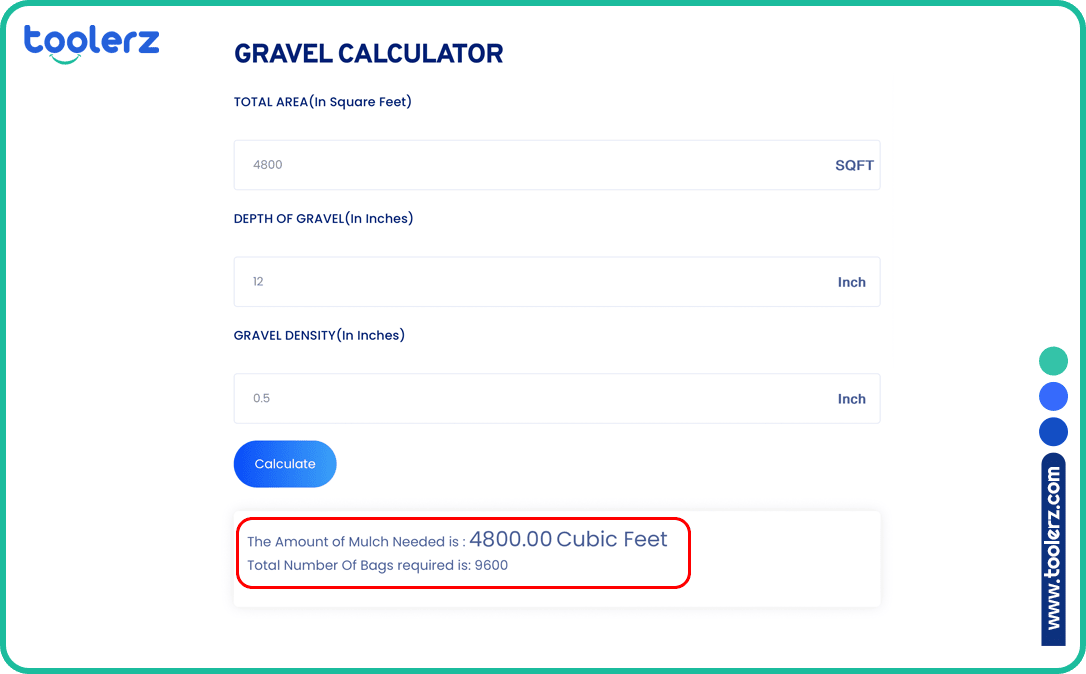
The Amount of Mulch Needed is : Cubic Feet
Total Number Of Bags required is:
What is Gravel Calculator?
Toolerz Gravel Calculator is a free online tool that helps users estimate the amount of gravel required for a specific project.
By entering the Total Area, Depth of Gravel, and Density of the Gravel, our calculator provides an accurate estimate of the quantity of gravel needed for that particular project.
This tool plays an important role in the construction segment and it is very easy to utilize this tool.
if you are unaware of using this tool, just follow the below simple steps:
How to Use Toolerz Gravel Calculator
STEP 1:
Visit our Gravel Calculator's Page here
STEP 2:
Enter the input parameters like
1. Total Area in Square Foot
2. Depth of the Gravelk in Inches
3. Density of the Gravel in Inches
STEP 3:
Cross-check the details entered and hit the calculate button
Our calculator will compute the quantity of gravel required based on the given inputs.
Benefits of Our Gravel Calculator Compared to Others
User-Friendly Interface: Our gravel calculator is designed with simplicity in mind, making it easy for anyone to use, regardless of their technical proficiency. Even a small contractor/ worker can understand our tool.
Accurate Results: We use precise formulas and updated density values for different types of gravel, ensuring that our calculations are accurate and reliable.
Versatility: Our calculator can handle a variety of projects, from small garden paths to large driveways, providing tailored results for each type of project.
Additional Features: Unlike many other calculators, our tool offers additional features such as cost estimation based on local gravel prices and the ability to save and print your calculations for future reference.
Mobile Compatibility: Our gravel calculator is fully optimized for mobile devices, allowing users to perform calculations at their fingertips.
For financial planning, check out our SIP Calculator to calculate your systematic investment plan returns.
Gravel Calculator Formula
The basic formula used by our gravel calculator is as follows:
Gravel Required=AreaxDepthxGravel Density
Where:
Area: The surface area of the project in square feet or square foot.
Depth: The desired depth of the gravel layer in inches.
Gravel Density: The density of the specific type of gravel being used, typically measured in pounds per cubic foot (lb/ft³) or kilograms per cubic meter (kg/m³).
Example:
Let us understand the same with an example.
Project: A rectangular garden path.
Length: 20 feet
Width: 5 feet
Depth: 3 inches
Gravel Density: 100 lb/ft³ (standard density for gravel)
Gravel Required=1.25 tons
How Much Gravel Do I Need?
Calculating the amount of gravel needed depends on the size of the project area and the depth of the gravel layer.
It is important to measure the length and width of the area and decide on the depth required for the gravel layer.
Using these measurements, you can utilize our gravel calculator to find the exact amount of gravel needed.
Go to Gravel Calculator Tool Here
Why Choose Our Gravel Calculator?
1. Accuracy: Our calculator uses precise algorithms to ensure accurate results, reducing the risk of over-ordering or under-ordering materials.
2. Efficiency: Quickly obtain the gravel quantity needed without complex manual calculations, saving time and effort.
3. Comprehensive Data: Includes a wide range of gravel types with specific densities for more tailored and precise results.
4. User Support: We offer customer support to help users with any questions or issues they may encounter while using the calculator.
5. Eco-Friendly: By providing accurate calculations, we help reduce material wastage, contributing to more sustainable construction and landscaping practices.
How Do I Calculate How Much Gravel I Need?
To calculate how much gravel you need, follow these steps:
Measure the Area: Determine the length and width of the area to be covered in feet or meters.
Decide on the Depth: Choose the depth of the gravel layer in inches or centimeters.
Input Values into the Calculator: Enter the measurements into the gravel calculator along with the gravel density.
Review the Results: The calculator will provide the total volume and weight of gravel required.
While planning material quantities, you can also manage your finances better using our Lumpsum Calculator for investment growth projections.
Key Features of Gravel Calculator
A Gravel Calculator is a practical tool designed to help users estimate the amount of gravel needed for a project.
Whether you're laying gravel for a driveway, garden path, or construction site, this tool simplifies the process.
One of the key features is its ability to calculate the volume of gravel required based on the length, width, and depth of the area to be covered.
The calculator may also allow users to input different gravel types (such as crushed stone or pea gravel), as density can vary.
Most gravel calculators provide customizable units, supporting both metric and imperial measurements (e.g., cubic yards or cubic meters).
Additionally, some tools offer the option to calculate gravel weight based on the volume, helping with transportation and cost estimation.
With its user-friendly interface, a gravel calculator saves time, ensures accurate measurements, and helps optimize material usage for landscaping or construction projects
How Much Gravel Should You Take?
To determine how much gravel you need, you should first know the area you want to cover and the desired depth. The basic formula is:
Gravel Volume = Length × Width × Depth
Convert all measurements to the same unit (usually feet), and then multiply. To convert the volume from cubic feet to tons (which gravel is typically sold in), divide the total cubic feet by 21.6 — since one ton of gravel roughly covers 21.6 cubic feet.
For example, for a 10 ft × 10 ft area at 2 inches depth:
Convert 2 inches to feet (2 ÷ 12 = 0.167), then:
10 × 10 × 0.167 = 16.7 cubic feet
16.7 ÷ 21.6 ≈ 0.77 tons
So, you'd need about 0.77 tons of gravel. Always round up slightly to account for compaction and spillage.
Applications of Gravel Calculator
A gravel calculator is a handy tool used to estimate the amount of gravel required for construction and landscaping projects.
Whether you're planning to build a driveway, patio, walkway, or garden path, this calculator helps you determine the right quantity of gravel based on the area size, depth, and gravel type.
Contractors, landscapers, and homeowners use gravel calculators to avoid over-ordering or underestimating materials, saving both time and money.
It ensures efficient budgeting and planning by giving accurate volume and weight calculations, usually in cubic meters or tons.
Conclusion of Using Gravel Calculator
Using a gravel calculator is a practical and efficient way to estimate the amount of gravel needed for any project. Whether you’re working on landscaping, driveway construction, or concrete mixing, this tool helps avoid both shortages and excess purchases.
By inputting measurements like area size and gravel depth, the calculator provides accurate quantity estimates, saving time and reducing costs. It also helps in planning the budget and managing resources better.
Overall, a gravel calculator simplifies the project planning process, making it easier for homeowners, contractors, and builders to make informed decisions.
This tool ensures you buy just the right amount of gravel, preventing waste and promoting efficient use of materials. It is user-friendly, quick, and reliable, making any gravel-related task smoother and more cost-effective.
Advantages of Using Gravel Calculator
Using a gravel calculator offers several benefits for both DIY enthusiasts and professionals. It helps accurately estimate the amount of gravel needed for a project, preventing both shortage and excess. This saves time and money by avoiding unnecessary purchases.
The calculator is easy to use just input the dimensions of your area, and it provides precise measurements in tons or cubic yards. It also reduces guesswork, making planning more efficient.
With accurate estimates, you can better manage your budget and project timeline. Additionally, a gravel calculator supports sustainable building by minimizing waste.
Overall, this tool simplifies project preparation, ensures accuracy, and helps you complete your work smoothly without delays or extra costs. It’s a must-have for anyone working on landscaping, construction, or drivew
Important FAQs
Q1: Can I use the gravel calculator for different types of gravel?
Ans: Yes, our calculator includes various types of gravel with specific densities to provide accurate results for different materials.
Q2: Do I need to account for compaction when using the gravel calculator?
Ans: Yes, it is advisable to consider compaction. Typically, gravel can compact by 10-20%, so you may want to add an extra 10-20% to your calculated amount.
Q3: Is the Toolerz gravel calculator free to use?
Ans: Yes, our gravel calculator is completely free to use for personal and enterprise www.toolerz.com .
Q4: Can the calculator estimate the cost of gravel?
Ans: Yes, our calculator can estimate the cost based on the local price per ton of gravel.
Q5: Can I save my calculations for future reference?
Ans: Yes, you can save and print your calculations for future use.
Q6: Is the calculator suitable for both small and large projects?
Ans: Our calculator is designed to handle projects of all sizes, from small garden paths to large commercial driveways.
Q7: How often is the gravel density data updated?
Ans: We update our gravel density data regularly to ensure accurate and up-to-date calculations.
Q8: Can the calculator be used on mobile devices?
Ans: Yes, our calculator is fully optimized for mobile use, allowing you to perform calculations on your smartphone or tablet.
Q9: Does the calculator take into account different measurement units?
Ans: Yes, our calculator allows you to switch between metric and imperial units for your convenience.
Q10: What if I encounter issues while using the calculator?
Ans: If you experience any problems, our customer support team is available to assist you. Use the contact page to submit the bug.
Q11:Can I use a Gravel Calculator for landscaping projects?
Ans:Absolutely! Whether it’s for a garden bed, patio, or path, the calculator helps you figure out how much gravel you’ll need to cover the space.
Q12:What is a gravel calculator?
Ans:A gravel calculator is a tool that helps you find out how much gravel you need for a project. It calculates the amount based on the area size, depth, and type of gravel you want to use.
Q13: Do I need to add extra gravel for settling or compaction?
Ans:Yes, it’s a good idea to order a little extra gravel to account for settling and compaction over time. Many people add an extra 10% to their total amount to ensure they have enough material for the job.
Q14:Can a gravel calculator help reduce waste?
Ans:Yes, by buying only what you need, it helps reduce leftover gravel and environmental waste.