HEA BEAMS WEIGHT CALCULATOR

What is Toolerz HEA Beams Weight Calculator?
The Toolerz HEA Beams Weight Calculator is an online tool that helps engineers, architects, and construction professionals determine the weight of HEA beams based on their dimensions and the density of the material.
How to Use Our HEA Beams Weight Calculator
Using our HEA Beams Weight Calculator is very simple. Here is a step-by-step procedure to use our tool:
Step 1: Visit our Website
Visit our website search for HEA Beams weight calculator in the search bar.
Select the drop-down and go to the page.
Step 2: Enter the Dimensions
Enter the following dimensions of the HEA beam:
- Height (H): The total height of the beam.
- Width (B): The width of the flange.
- Flange Thickness (Tf): The thickness of the flange.
- Web Thickness (Tw): The thickness of the web (vertical part connecting the flanges).
Step 3: Select Material
Choose the material of the HEA beam from the available options. Common materials include steel, aluminum, and other alloys. The density of the material will be used in the weight calculation.
HEA ranges from HEA 100 to HEA 1000
Step 4: Calculate Weight
Click the ‘Calculate’ button to get the result. The calculator will provide the weight of the HEA beam per unit length (e.g., kilograms per meter).
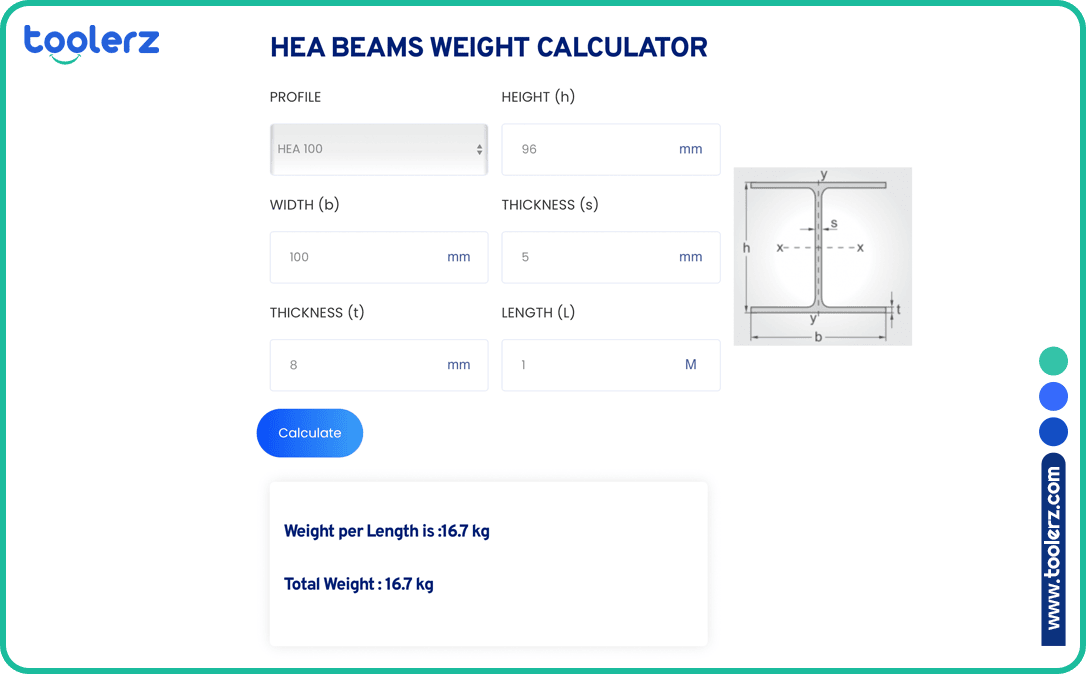
Step 5: Review Results
Review the calculated weight. You can use this information for further project planning, cost estimation, and logistical arrangements.
Benefits of Using HEA Beams Weight Calculator
The HEA Beams Weight Calculator is an essential tool for engineers, architects, and construction professionals.
It helps accurately determine the weight of HEA (European wide flange) steel beams based on their dimensions and length.
This saves time and eliminates the need for complex manual calculations.
One of the key benefits is improved material planning and cost estimation, allowing users to order just the right amount of steel, minimizing waste and budget overruns.
It also supports various unit systems (metric and imperial), making it versatile for international use.
By providing instant and precise results, the calculator aids in structural design, logistics, and load analysis.
Whether you're designing a building frame or estimating transport weight, this tool ensures efficiency and reliability.
Overall, using an HEA Beams Weight Calculator streamlines project planning, enhances accuracy, and supports smart decision-making in steel construction.
Formula Used in the HEA Beams Weight Calculator
The weight of an HEA beam is calculated using the formula that considers its dimensions and the density of the material. The basic formula is:
Weight=Volume x Density
Where the volume (V) is calculated based on the beam’s cross-sectional dimensions.
For financial planning, you can also check out our Interest Calculator to estimate earnings on your savings and investments.
Detailed Formula
Volume=(HxTw)+2x(BxTf-TwxTf)
Weight=Volume x Density
Example Calculation
Dimensions:
- Height (H): 200 mm
- Width (B): 150 mm
- Flange Thickness (Tf): 10 mm
- Web Thickness (Tw): 6 mm
- Material: Steel (Density = 7850 kg/m³)
Calculation:
Volume = (200mm × 6mm) + 2 × (150mm × 10mm - 6mm x 10mm)
Volume = 1200mm^2+2880mm^2
Volume = 4080mm^2
Weight = 0.00408m^2×7850kg/m³
Weight = 32.028kg/m
So, the weight of the HEA beam is 32.028 kg per meter.
To balance your work and rest efficiently, explore our Sleep Calculator for better daily planning.
How Do You Measure the Weight of an I-Beam?
To measure the weight of an I-beam, you need to know its dimensions and material density. The key measurements include the flange width, web thickness, beam height, and length.
These dimensions help calculate the cross-sectional area. Then, you multiply the area by the beam’s length to get the volume.
To find the weight, multiply the volume by the density of the material—typically steel, which has a density of about 7,850 kg/m³.
An easier method is to use standard weight charts or an I-beam weight calculator, which provides weight per meter based on size and type.
This helps in construction planning, load calculations, and transport estimates. Always double-check units to ensure accuracy, especially when converting between metric and imperial systems.
Applications of HEA Beams Weight Calculator
An HEA Beams Weight Calculator is a practical tool used in construction, architecture, and structural engineering to quickly determine the weight of HEA (European wide flange) beams.
These calculators help professionals estimate load-bearing capacities and material requirements accurately, which is essential for structural safety and cost estimation.
Common applications include designing steel structures such as bridges, buildings, and industrial frameworks. Fabricators and engineers use the calculator to select appropriate beam sizes and ensure compliance with weight limitations.
It also assists in planning transportation and storage, reducing errors and material waste.
For project planners, it simplifies budgeting by offering quick calculations without manual formulas. Whether you’re estimating the weight for a single beam or an entire batch, this tool streamlines the process.
Easy to use and highly reliable, the HEA Beams Weight Calculator is essential for efficient and accurate steel construction planning.
Key Features of Using HEA Beams Weight Calculator
An HEA beams weight calculator is a handy tool designed to simplify the process of determining the weight of HEA (European wide flange) steel beams. One of its key features is accuracy it quickly provides precise weight estimates based on standard dimensions and length.
It supports custom input options, allowing users to enter specific measurements like beam length, height, and flange width. The calculator is also user-friendly, often requiring just a few clicks to generate results, making it suitable for both professionals and students.
Many versions offer unit conversion, helping users switch between metric and imperial units easily. In addition, instant results save time and reduce manual calculation errors. This tool is especially useful in construction, structural engineering, and metal fabrication projects, where accurate weight data is essential for planning, transportation, and cost estimation.
Advantages of Using HEA Beams Weight Calculator
Using an HEA beams weight calculator offers several advantages, especially for engineers, architects, and builders. It helps quickly determine the exact weight of HEA steel beams based on their dimensions, saving time compared to manual calculations.
This accuracy is crucial for designing safe and efficient structures, ensuring that beams can support the required loads without errors. The calculator also aids in estimating material costs, helping with budgeting and resource planning.
Additionally, it simplifies project management by providing instant results, reducing the chances of mistakes in weight estimation. Overall, the HEA beams weight calculator is a valuable tool that improves precision, saves time, and supports effective construction planning.
Frequently Asked Questions
Q1: What is an HEA Beam?
Ans: An HEA beam is a European standard wide-flange beam with an H-shaped cross-section, known for its high load-bearing capacity and used in various construction and engineering applications.
Q2: Why is calculating the weight of HEA beams important?
Ans: Calculating the weight is crucial for structural design, cost estimation, transportation logistics, and ensuring the safety and stability of the construction project.
Q3: How accurate is the Toolerz HEA Beams Weight Calculator?
Ans: Our calculator is highly accurate as it also depends on the input dimensions.
Q4: Can the calculator be used for different materials?
Ans: Yes, the calculator allows you to select different materials, such as steel, aluminum, and other alloys, to calculate the weight accurately based on the material density.
Q5: Is the Toolerz calculator free to use?
Ans: Yes, our HEA Beams Weight Calculator is available for free for all users www.toolerz.com .
Q6: Can I save my calculations for future reference?
Ans: No, as of now there is no registration facility and database attached to any of our tools so you cannot save the calculations.
Q7: How do I know which dimensions to input into the calculator?
Ans: You need to input the height, width, flange thickness, and web thickness of the HEA beam. These dimensions are usually provided in the beam’s specifications or technical drawings.
Q8: Can the calculator handle custom beam sizes?
Ans: Yes, the calculator is designed to handle both standard and custom beam sizes, allowing you to input specific dimensions for accurate weight calculations.
Q9: How do I select the material density?
Ans: The calculator provides a dropdown menu to select the material, and it automatically applies the correct density for the selected material.
Q10: What units does the calculator use?
Ans: The calculator primarily uses metric units (millimeters for dimensions and kilograms for weight) but can be adapted to use imperial units if required.
Q11: Can I calculate the weight for multiple HEA beams at once?
Ans: Some advanced calculators offer the option to calculate the total weight for multiple beams by entering the number of beams along with their dimensions.
Q12:Are HEA beams different from other steel beams?
Ans: Yes, HEA beams have a wide flange and are commonly used in European construction. They are lighter than HEB beams but still strong and stable, making them ideal for various structural needs..
Q13:What details do I need to use an HEA Beams Weight Calculator?
Ans: You usually need the HEA beam size (like HEA 100, HEA 200, etc.) and the beam length. Some calculators may also let you select the unit, like meters or feet.
Q14: Is the HEA beams weight calculator free to use?
Ans:Yes, many online HEA beams weight calculators are free to use. You can access them without any cost, which makes them a valuable tool for anyone working with steel beams in construction projects.
Q15: Can this calculator be used for other beam types like HEB or IPE?
Ans:No, this specific calculator is for HEA beams only. For HEB or IPE beams, you should use a separate weight calculator designed for those profiles.