LCM CALCULATOR ONLINE
What is Toolerz LCM Calculator?
Toolerz LCM Calculator is a free web tool designed to quickly and accurately calculate the Least Common Multiple (LCM) of two or more numbers.
LCM, or Least Common Multiple, is the smallest positive integer that is divisible by two or more numbers.
For example, the LCM of 12 and 18 is 36.
LCM is widely used in solving problems that involve synchronization, such as when trying to determine the next time two repeating events will occur simultaneously.
Key Features of Our LCM Calculator
Our LCM Calculator stands out for the following key features:
- Ease of Use: Designed with a simple and user-friendly interface, anyone from a school student to a professional can use this tool effortlessly.
- Speed: Our tool provides instant results after hitting the calculate button.
- Accuracy: We can say our tool is 100% accurate
- Support for Multiple Numbers: You can input more than two numbers to calculate the LCM of multiple integers at once.
How to Use Our LCM Calculator
Using the LCM Calculator on our web page is simple. Here’s how you can use it step-by-step:
- Go to the LCM Calculator: Visit our website and search for the LCM Calculator tool.
- Input Your Numbers: Enter the two or more numbers for which you want to calculate the LCM. For example, you can input "24" and "36."
- Click Calculate: Once your numbers are entered, click on the “Calculate” button.
- Get Your Result: The LCM Calculator will instantly display the least common multiple of the numbers you entered.
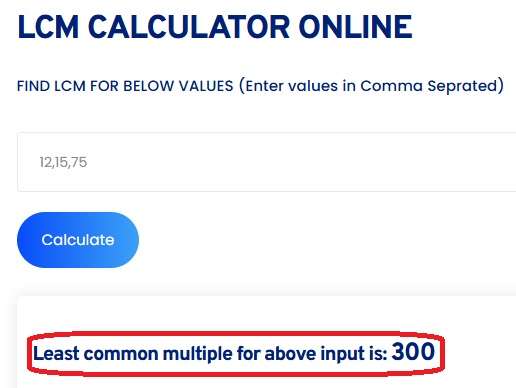
Benefits of LCM Calculator
An LCM (Least Common Multiple) calculator is a handy tool that helps you quickly find the smallest multiple shared by two or more numbers.
One of the main benefits is time-saving—instead of performing long manual calculations, the tool gives you instant results with just a few clicks
It is especially useful for students, teachers, and professionals dealing with mathematics, fractions, or scheduling problems.
The LCM calculator also helps in solving real-world problems such as aligning repeating events or finding common denominators in fractions.
Using an LCM calculator improves accuracy, reduces human error, and makes learning math more approachable and less stressful.
Whether you're preparing for exams or working on complex problems, this tool boosts efficiency and confidence.
Overall, the LCM calculator is a simple yet powerful aid for anyone who wants to make quick and accurate calculations in schoolwork or everyday tasks.
LCM Calculator by Division Method
One of the classic methods to calculate LCM is the division method. Here’s how you can do it using our LCM Calculator:
- List the Numbers: First, list the numbers whose LCM you want to find, such as 24 and 36.
- Divide by the Smallest Prime Number: Start dividing the numbers by the smallest prime number that can divide at least one of the numbers (typically starting with 2).
- Repeat Until All Numbers Are Divisible by 1: Continue dividing the results by prime numbers until all the numbers become 1.
For example, to find the LCM of 24 and 36 using this method:
- 24 | 2 → 12 | 2 → 6 | 2 → 3 | 3 → 1
If you're looking for financial planning tools, try our SIP Calculator to estimate your investment returns.
- 36 | 2 → 18 | 2 → 9 | 3 → 3 | 3 → 1
LCM is found by multiplying all the divisors: 2 × 2 × 2 × 3 × 3 = 72.
How to Calculate LCM?
To calculate the LCM of two or more numbers, you can use several methods:
- Prime Factorization Method: Factorize the numbers into their prime factors, then multiply the highest power of each prime that appears.
- Division Method: As described above, divide the numbers by their prime factors and continue dividing until all the numbers become 1.
- Listing Multiples Method: List the multiples of each number until you find the first common multiple.
If you're looking for financial planning tools, try our SIP Calculator to estimate your investment returns.
What is the LCM of 24 and 36?
Using any of the above methods, let’s calculate the LCM of 24 and 36.
Prime Factorization Method:
24 = 2^3 × 3
36 = 2^2 × 3^2
LCM = 2^3 × 3^2 = 72.
Thus, the LCM of 24 and 36 is 72.
Examples of LCM Calculation
Here are a few examples of LCM calculations:
LCM of 12 and 15:
Prime Factorization:
12 = 22 × 3
15 = 3 × 5
LCM = 22 × 3 × 5 = 60.
You can also try our Interest Calculator to simplify your financial planning and make better investment decisions.
What is the LCM of 300 and 550?
The Least Common Multiple (LCM) of two numbers is the smallest number that is a multiple of both. To find the LCM of 300 and 550, follow these simple steps:
-
Prime Factorization:
-
300 = 2² × 3 × 5²
-
550 = 2 × 5² × 11
-
-
Choose the highest power of each prime number:
-
2², 3, 5², 11
-
-
Multiply them together:
LCM = 2² × 3 × 5² × 11 = 4 × 3 × 25 × 11 = 3300
So, the LCM of 300 and 550 is 3300. This means 3300 is the smallest number that both 300 and 550 can divide evenly.
Knowing how to find the LCM is useful for solving problems involving time intervals, fractions, and aligning repeated events.
Applications of LCM Calculator
An LCM (Least Common Multiple) Calculator is a valuable tool for quickly finding the smallest common multiple of two or more numbers.
It plays an important role in simplifying mathematical problems and is widely used in education, engineering, and computer programming.
In schools, students and teachers use LCM calculators to solve problems related to fractions, time intervals, and ratios.
It helps learners understand number relationships more efficiently. In real-life scenarios, LCM is essential for planning events, such as syncing repeating schedules or tasks.
Engineers and technicians use it for aligning machine cycles or timing sequences. Programmers also apply LCM in coding algorithms and handling loops or periodic tasks.
With its ability to deliver accurate results instantly, the LCM calculator enhances productivity, reduces errors, and supports logical problem-solving, making it a helpful resource in both academic and professional settings.
Advantages of LCM Calculator
An LCM (Least Common Multiple) Calculator offers a quick and accurate way to find the smallest common multiple of two or more numbers.
This tool is especially helpful for students, teachers, and professionals working with fractions or scheduling tasks.
One of its main advantages is time-saving efficiency—you can get instant results without the need for lengthy manual calculations.
It also helps in reducing human error, making your math problems more reliable. Whether you're simplifying fractions, solving algebraic equations, or aligning periodic tasks, an LCM calculator provides precise and consistent outcomes.
Most online calculators are easy to use, mobile-friendly, and completely free, making them accessible to everyone.
By eliminating the complexity of finding the least common multiple manually, this tool enhances learning and speeds up problem-solving.
It’s a valuable addition for anyone looking to simplify their math work with confidence and accuracy.
Conclusion of LCM Calculator
In conclusion, an LCM (Least Common Multiple) Calculator is a simple yet powerful tool designed to make math tasks easier and faster.
Whether you're a student solving homework problems or a professional working with schedules or data, this calculator helps eliminate the guesswork involved in finding common multiples.
It delivers quick, accurate results that save time and reduce errors, making it ideal for everyday use. With its user-friendly design and instant output, it simplifies complex calculations that might otherwise take longer to solve manually.
Most importantly, it supports better learning and understanding of mathematical concepts by offering clear and precise results.
Overall, the LCM calculator is a must-have tool for anyone who wants to improve their efficiency and accuracy in math-related tasks.
Its accessibility and reliability make it an essential resource in both educational and practical settings.
Frequently Asked Questions
Q1: What are the advantages of the Toolerz LCM Calculator?
Ans: Our LCM Calculator is entirely free, and offers additional educational content to help users understand the process of LCM calculation.
Q2: Is the Toolerz LCM Calculator mobile-friendly?
Ans: Yes, our LCM Calculator is optimized for all devices www.toolerz.com .
Q3: Can I calculate the LCM of more than two numbers?
Ans: Yes, you can enter as many numbers as you need, and the calculator will compute the LCM.
Q4: Do I need an account to use the LCM Calculator?
Ans: No, there’s no need to sign up or create an account to use the LCM Calculator on our website.
Q5: How accurate is the Toolerz LCM Calculator?
Ans: Our calculator uses advanced algorithms to ensure 100% accuracy.
Q6: What is the maximum number of inputs supported?
Ans: You can input multiple numbers, and the calculator will handle all computations efficiently.
Q7: Does the calculator show the steps involved in the calculation?
Ans: Yes, in addition to providing the result, the LCM Calculator also explains the steps.
Q8: Is there a downloadable version of the LCM Calculator?
Ans: Currently, the calculator is only available online, and it is accessible from any browser.
Q9: Can the LCM Calculator handle decimal numbers?
Ans: No, the LCM is traditionally calculated for whole numbers.
Q10: What is the division method for LCM?
Ans: The division method involves dividing the given numbers by prime factors and continuing until all the numbers become 1.
Q11: Why is LCM important?
Ans: LCM is important for solving problems involving time synchronization, gear ratios, and fraction operations.
Q12: How do I calculate the LCM manually?
Ans: You can use methods like prime factorization, division method, or listing multiples.
Q13: How does the LCM relate to GCD?
Ans: The product of the LCM and GCD of two numbers equals the product of the numbers themselves.
Q14: Why is LCM important?
Ans: LCM is commonly used in:
Solving problems with fractions.
Finding common denominators.
Scheduling tasks or events that repeat at different intervals.
Simplifying mathematical problems in algebra and arithmetic.
Q15: Is the LCM Calculator suitable for students?
Ans: Definitely! It is perfect for students who want to double-check their homework or understand how LCM works. It’s also helpful for teachers and parents.
Q16: Can the LCM Calculator handle large numbers?
Ans: Yes, most LCM Calculators can handle both small and large numbers. However, it’s a good idea to ensure that the numbers you’re using are reasonable for the tool's capabilities.
Q17: What is an LCM Calculator?
Ans: An LCM Calculator is a tool that helps you find the Least Common Multiple (LCM) of two or more numbers. The LCM is the smallest number that is a multiple of all the numbers in the set.
Q18: Is the LCM Calculator free to use?
Ans: Yes, many online LCM Calculators are free and easy to access without sign-up.