METAL WEIGHT CALCULATOR
What is Toolerz Metal Weight Calculator?
Toolerz Metal Weight Calculator is an online tool designed to help users calculate the weight of different types of metals.
Whether you are a construction professional, an engineer, or a DIY enthusiast, calculating the weight of metals is very important.
Toolerz's Metal Weight Calculator gives an easy-to-use interface for calculating the weight of metals based on their type, dimensions, and density.
Key Features
It has many unique features as listed below: www.toolerz.com
- User-Friendly Interface: The tool has a user-friendly interface which helps the user to understand and operate easily.
- Huge Metal Database: Supports a wide range of metals, including steel, aluminum, copper, brass, titanium, and more.
- High Precision: Provides highly accurate weight calculations by factoring in the density and volume of the selected metal.
- Instant Results: Delivers immediate weight calculations without any lag, ensuring efficiency in use.
- Free tool: The calculator is completely free.
How to Use?
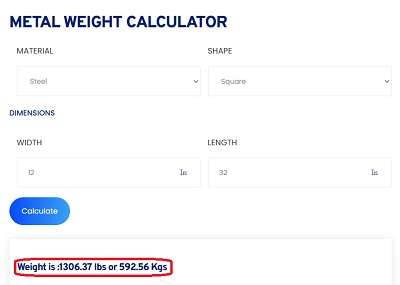
Select the Metal Type:
Choose the type of metal you want to calculate the weight for, such as steel, aluminum, brass, etc.
Enter the Metal Shape:
Select the shape of the metal from options like round bar, square bar, flat bar, sheet, plate, or pipe.
Input the Dimensions:
Enter the required dimensions of the metal piece. For example, for a steel bar, you need to provide the diameter and length.
Choose the Unit of Measurement:
Select the unit of measurement (millimeters, centimeters, inches, or feet) that you are comfortable with.
Click on Calculate:
Hit the 'Calculate' button to obtain the weight of the metal piece.
Results:
The calculator will display the weight of the metal based on the provided dimensions and type. You can also view a detailed breakdown of the calculations.
Benefits of Metal Weight Calculator
A metal weight calculator is a handy tool used to estimate the weight of different metal materials based on their shape, size, and type.
It is especially useful for engineers, manufacturers, and construction professionals who work with metals regularly. One of the main benefits is accuracy it helps you get precise weight estimates without doing manual math.
This is important when planning transport, costs, or storage space. The calculator supports various shapes like rods, sheets, pipes, and more, making it versatile for different projects.
It also allows you to select from multiple metal types, such as steel, aluminum, copper, and brass.
Most metal weight calculators are easy to use and available online for free. By using this tool, you save time, reduce errors, and improve project planning.
Whether you're ordering materials or budgeting for a job, a metal weight calculator is a smart and efficient solution.
Steel Bar Weight, Density, and Formula
Steel Bar Weight
The weight of a steel bar depends on its shape, size, and length. Typically, steel bars are used in construction for reinforcement and come in various forms like round bars, flat bars, or rebars.
Steel Bar Density
Steel has a standard density of approximately 7,850 kg/m³ (kilograms per cubic meter). This density is essential when calculating the weight of a steel bar since weight is a function of both volume and density.
Formula to Calculate Metal Weight
To calculate the weight of a metal piece, you can use the following formula:
Weight=Volume×Density
For financial planning, check out our Home Loan Calculator to estimate your monthly EMI and plan your finances better.
Applications
- Construction and Engineering: For estimating material costs and structural weights.
- Manufacturing: Useful for calculating material requirements and costs in the production process.
- Transportation: Helps in planning logistics and transportation costs by knowing the weight of metal loads.
- Metal Trading: Assists traders in determining the weight and price of metal pieces.
- DIY Projects: Supports hobbyists and home builders in sourcing the right quantity of materials.
- Scrap Metal Recycling: Helps recyclers estimate the weight of collected metal for valuation purposes.
- Research and Development: Useful for R&D professionals to analyze the weight and material properties for prototypes.
- Metal Fabrication: Facilitates the calculation of cut pieces for customized fabrication projects.
- Inventory Management: Aids in managing inventory by calculating stock weight.
- Education: Supports students and educators in learning about metal properties and calculations.
How Much Does Metal Weigh?
The weight of metal depends on its density and the volume of the metal. Different metals have different densities, meaning some are heavier than others.
For example, lead is much denser and heavier than aluminum. The density of a material is typically measured in grams per cubic centimeter (g/cm³).
To calculate the weight of a specific amount of metal, you can use the formula:
Weight = Density × Volume
For instance, the density of iron is about 7.87 g/cm³, while aluminum is around 2.70 g/cm³. So, if you have 1 cubic centimeter of iron, it will weigh about 7.87 grams, whereas 1 cubic centimeter of aluminum weighs only 2.70 grams.
Understanding the weight of metals is crucial for industries like construction, manufacturing, and aerospace, where the right material needs to be chosen based on both strength and weight considerations.
Advantages of Metal Weight Calculator
A metal weight calculator offers several practical benefits for engineers, fabricators, and metal traders.
One of its key advantages is accuracy—by inputting material type, dimensions, and shape, users can quickly estimate the exact weight of metals like steel, aluminum, copper, and more. This helps avoid costly mistakes in planning and purchasing.
Another major benefit is time-saving. Instead of referring to complex charts or manual calculations, users can get instant results with just a few clicks.
It also aids in cost estimation, allowing businesses to plan budgets effectively and avoid material wastage.
Moreover, a metal weight calculator supports logistics and transportation planning by helping determine shipping weights in advance.
Whether for construction, manufacturing, or academic purposes, this tool simplifies workflows and boosts efficiency.
Overall, it’s a reliable, user-friendly resource that enhances decision-making across various industries dealing with metal materials.
If you are also interested in managing your investments, try our Investment Calculator to calculate the potential returns on your investments.
Conclusion of Metal Weight Calculator
In conclusion, a Metal Weight Calculator is a highly valuable tool for professionals across construction, manufacturing, and engineering industries.
It simplifies the process of calculating the weight of various metal types and shapes, saving both time and effort. With just a few inputs—such as material type, dimensions, and quantity—users can get accurate weight estimates instantly.
This helps in planning, cost estimation, and logistics, reducing errors and improving project efficiency. Whether you're working with steel, aluminum, copper, or any other metal, this calculator ensures precision and consistency.
Its user-friendly interface and quick results make it ideal for both technical experts and general users.
Ultimately, a Metal Weight Calculator enhances workflow, improves accuracy, and supports smarter decision-making in metal-related tasks.
Frequently Asked Questions
Q1: What metals can I calculate with this tool?
Ans: You can calculate weights for various metals, including steel, aluminum, brass, copper, titanium, and more.
Q2: Is the Metal Weight Calculator free to use?
Ans: Yes, our Metal Weight Calculator is completely free.
Q3: Can I use the calculator offline?
Ans: No, you need an internet connection to access the calculator on our website.
Q4: Does the calculator provide weight in both kilograms and pounds?
Ans: Yes, it provides results in multiple units, including kilograms, pounds
Q5: How accurate is the Metal Weight Calculator?
Ans: We can say it is 100% accurate
Q6: Does the calculator consider surface coatings or treatments?
Ans: No, the calculator does not account for additional coatings or surface treatments. It calculates the weight based purely on the metal's dimensions and density.
Q7: Is the Metal Weight Calculator suitable for use in commercial projects?
Ans: Yes, it is ideal for commercial applications where accurate metal weight estimations are needed, such as construction, manufacturing, and metal trading.
Q8: Does the calculator support high-density metals like tungsten or depleted uranium?
Ans: Yes, the calculator includes a wide range of metals, including high-density options like tungsten. For specialty metals, always check the metal list for confirmation.
Q9: Can I use the calculator for non-metal materials like plastic or wood?
Ans: No, the calculator is specifically designed for metals. It uses the unique density values associated with different types of metal.
Q10: Can I calculate weight for metal alloys?
Ans: Yes, the calculator allows users to select from a variety of common metal alloys.
Q11: Why is it important to calculate metal weight?
Ans: Knowing the weight of metal is essential for estimating transportation costs, material pricing, and structural strength. It also helps in inventory management and reducing material waste.
Q12: Can I calculate the weight of multiple metal objects at once?
Ans: Yes, most calculators allow you to enter the number of items to get the total weight. This is particularly useful for bulk orders or large construction projects.
Q13: Can I use this tool for any metal?
Ans: Yes, most calculators support a wide range of metals like steel, aluminum, brass, copper, and iron. Just select the correct type from the list before entering the size.
Q14: Does the type of metal affect the weight?
Ans: Yes, different metals have different densities. For example, steel is heavier than aluminum. That’s why it’s important to select the correct metal type in the calculator.
Q15: Can the Metal Weight Calculator be used for different types of metals?
Ans: Yes, the Metal Weight Calculator can be used for a variety of metals, such as steel, aluminum, copper, brass, and more. The calculator adjusts for each metal's density, ensuring that you get an accurate weight estimate based on the specific metal you are using.
Q16: What is a Metal Weight Calculator?
Ans: A Metal Weight Calculator is an online tool used to calculate the weight of a metal based on its dimensions and material type. It helps to estimate the weight of metal objects like bars, sheets, pipes, or rods, making it easier for manufacturers, engineers, and construction professionals to plan projects.
Q17: How does a Metal Weight Calculator work?
Ans: The calculator uses the metal’s density along with the dimensions you provide (like length, width, thickness) to calculate the weight. Different metals have different densities, so the calculator adjusts accordingly.