MS ANGLE WEIGHT CALCULATOR
What is MS Angle Weight Calculator?
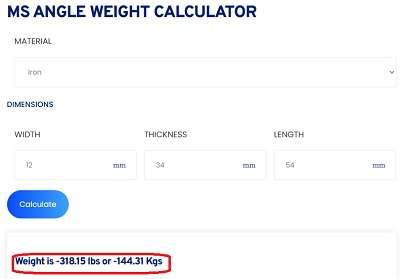
Toolerz MS Angle Weight Calculator is an online tool that helps calculate the weight of Mild Steel angles based on the dimensions (length, width, and thickness) and density of the material.
MS angles, also known as L-angles, are structural steel components shaped like the letter "L". They are used in a wide range of applications, including construction, frame building, and reinforcement purposes.
Key Features of Our MS Angle Weight Calculator
Our MS Angle Weight Calculator offers several unique features that set it apart from other tools available online:
- User-Friendly Interface: The calculator is designed with a simple and intuitive interface, making it accessible to users of all technical backgrounds.
- Instant Results: Get precise weight calculations in real-time, allowing for quick decision-making.
- Multiple Unit Options: Supports various units of measurement (metric and imperial), catering to users from different regions.
- Customizable Inputs: Allows users to input specific dimensions (length, width, thickness) and density of the material.
- High Accuracy: Utilizes the standard formula for MS angle weight calculation, ensuring reliable results.
- Free to Use: Our calculator is available free of charge with no hidden costs or subscription requirements.
- Mobile Friendly: Optimized for use on all devices, including smartphones and tablets, for convenient access anywhere.
- Secure and Private: No personal data is required, and all calculations are done securely on your browser.
How to Use Our MS Angle Weight Calculator
Using our MS Angle Weight Calculator is very simple. Follow these steps to use the tool:www.toolerz.com
- Visit the Website: Go to our website www.toolerz.com and search for MS Angle Weight Calculator.
- Input the Dimensions:
- Enter the length of the MS angle in your preferred unit (e.g., meters, feet).
- Enter the width of the MS angle.
- Enter the thickness of the MS angle.
- Select the Density: Input the density of mild steel, which is typically around 7850 kg/m³.
- Choose the Units: Select your preferred units of measurement (metric or imperial).
- Click on ‘Calculate’: Hit the ‘Calculate’ button to compute the weight.
- Review the Result: The tool will instantly display the weight of the MS angle based on the provided inputs.
Benefits of MS Angle Weight Calculator
An MS (Mild Steel) angle weight calculator is a handy tool used to calculate the weight of steel angles based on size and length. One of the main benefits is accuracy it quickly gives precise weight results, saving time and reducing manual errors.
This tool is especially useful for engineers, fabricators, and construction professionals who need to estimate material requirements.
By knowing the exact weight, you can plan transport, costs, and structural load more effectively.
The calculator typically requires inputs like length, width, thickness, and quantity, and provides instant results. It's easy to use, available online for free, and supports various unit measurements.
Whether you're preparing a quote or managing inventory, the MS angle weight calculator simplifies your work.
Overall, it helps improve efficiency, accuracy, and project planning in construction and metalworking industries.
MS Angle Weight Calculation (50x50x6 mm) Example
Let's calculate the weight of an MS angle with the following dimensions:
- Width (W): 50 mm
- Height (H): 50 mm
- Thickness (T): 6 mm
- Length (L): 1 meter (1000 mm)
- Density (ρ): 7850 kg/m³
Formula for MS Angle Weight Calculation
The formula to calculate the weight of an MS angle is:
Weight (kg)=(Width (W)+Height (H)−Thickness (T)/1000 )×Thickness (T)×Length (L)×Density (ρ)
Calculation Steps
-
Convert Dimensions to Meters: Since density is in kg/m³, convert all measurements to meters.
- Width (W) = 50 mm = 0.05 m
- Height (H) = 50 mm = 0.05 m
- Thickness (T) = 6 mm = 0.006 m
- Length (L) = 1000 mm = 1 m
-
Apply the Formula:Weight (kg)=(Width (W)+Height (H)−Thickness (T)/1000 )×Thickness (T)×Length (L)×Density (ρ)
- Calculate the Weight: Thus, the weight of the MS angle (50x50x6 mm) is approximately 4.43 kg per meter.
For other useful calculations, check out our Age Calculator to determine your exact age in years, months, and days.
Applications:
Our MS Angle Weight Calculator is widely used in various fields, including:
- Construction: For determining the weight of MS angles required in building structures, supports, frames, and reinforcements.
- Manufacturing: To calculate the weight of steel components in machinery, vehicles, and equipment.
- Engineering: For structural analysis, design, and material estimation.
- Transportation and Logistics: To estimate the shipping weight and plan for transportation.
- Metal Trading: To determine the cost and pricing based on the weight of steel angles.
- DIY Projects: For hobbyists and small-scale fabricators to estimate materials needed for home projects.
What Is the Load Limit for Angle Iron?
The load limit for angle iron depends on various factors such as its material grade, dimensions, length, and how it is supported.
Angle iron is commonly made from mild steel and is often used in construction and structural applications.
To determine its load-bearing capacity, engineers consider the cross-sectional area, the type of load (tension, compression, or shear), and the span between supports.
For instance, a thicker and longer piece of angle iron can support more weight, but the material's grade also plays a crucial role in determining strength.
Typically, the load limit is calculated based on engineering formulas or design codes. It is essential to consult a structural engineer or refer to relevant design standards to ensure safe and efficient use of angle iron in your project, as overloading can lead to deformation or failure.
Advantages of MS Angle Weight Calculator
The MS Angle Weight Calculator offers several practical advantages for professionals in construction, fabrication, and metalwork industries.
One of its biggest benefits is accuracy—it allows users to quickly determine the exact weight of mild steel angles by entering basic dimensions like length, width, and thickness.
This eliminates guesswork and reduces the risk of material wastage.
Another key advantage is time efficiency. With instant results, users can plan projects faster, estimate costs more accurately, and streamline procurement and logistics.
The tool is especially useful when managing large inventories or preparing bulk orders, helping businesses save time and money.
Its user-friendly interface and compatibility with different unit systems also make it ideal for both domestic and international use.
Overall, the MS Angle Weight Calculator simplifies project planning, improves accuracy, and supports smarter decision-making in steel structure development.
Additionally, if you need to compress images for your project, you can use our PNG Compressor to reduce the size of your PNG files without losing quality.
Conclusion of MS Angle Weight Calculator
The MS Angle Weight Calculator is an essential tool for engineers, contractors, and fabricators who work with mild steel angles.
It offers a fast and accurate way to calculate the weight of MS angles based on dimensions such as length, thickness, and width.
This eliminates the need for manual calculations, reduces errors, and streamlines planning processes. With precise weight information, users can manage inventory better, estimate costs more effectively, and ensure smoother logistics.
The calculator is user-friendly, reliable, and suitable for both small-scale and large-scale projects.
In conclusion, the MS Angle Weight Calculator enhances efficiency, supports accurate decision-making, and simplifies complex calculations, making it a must-have tool for anyone dealing with steel structures.
Frequently Asked Questions
Q1: What is an MS Angle Weight Calculator?
Ans: An MS Angle Weight Calculator is an online tool that calculates the weight of Mild Steel angles based on dimensions and material density.
Q2: How accurate is the MS Angle Weight Calculator?
Ans: The calculator provides highly accurate results using standardized formulas and precise density values.
Q3: Can I use the calculator for different materials?
Ans: Yes, by inputting the specific density of the material you are calculating, you can use it for other types of steel or metals.
Q4: Is the tool free to use?
Ans: Yes, our MS Angle Weight Calculator is completely free with no hidden charges.
Q5: Do I need to download any software to use the calculator?
Ans: No, the calculator is web-based and does not require any software download.
Q6: Can the tool be used offline?
Ans: No, you need an internet connection to access and use the calculator on our website.
Q7: What units does the calculator support?
Ans: The calculator supports both metric (mm, cm, m) and imperial units (inches, feet).
Q8: How do I know if the calculation is correct?
Ans: Our tool uses industry-standard formulas for calculations. You can cross-check the results with manual calculations if needed.
Q9: Can I calculate the weight for custom-sized MS angles?
Ans: Yes, the calculator allows input of custom dimensions for precise calculations.
Q10: Does the calculator provide results in pounds or kilograms?
Ans: The tool provides results in both kilograms (kg) and pounds (lbs).
Q11: What is the density value used in the calculator?
Ans: The default density value used is 7850 kg/m³, which is the standard density for mild steel.
Q12: Is my data secure while using the calculator?
Ans: Yes, we do not store any personal data, and all calculations are performed securely in your browser.
Q13: Can I use the tool on mobile devices?
Ans: Absolutely, our calculator is fully optimized for mobile use.
Q14: How often is the tool updated?
Ans: We regularly update the tool to improve performance and accuracy based on user feedback.
Q15: Can I share the results with others?
Ans: Yes, you can easily share the results by copying the output or taking a screenshot.
Q16: Why should I use an MS Angle Weight Calculator?
Ans: Using an MS Angle Weight Calculator can help you:
Estimate the total weight for transportation and material handling.
Calculate the material cost based on weight.
Plan the required steel quantity for construction projects.
Q17: Do I need any technical knowledge to use the calculator?
Ans: No, the tool is user-friendly. You just need to know the length, width, and thickness of the MS angle you are using.
Q18: Is the weight shown by the calculator accurate?
Ans: The calculator gives a close estimate. Actual weight may vary slightly based on manufacturer tolerance or material grade. For precise weight, always check with your supplier.
Q19: Can the MS Angle Weight Calculator be used for different sizes of angles?
Ans: Yes, the MS Angle Weight Calculator can handle a wide range of angle sizes, from small to large. Whether you are working with a small steel angle or a larger industrial one, the tool can calculate the weight based on your input dimensions.
Q20: Can I calculate the weight of both equal and unequal MS angles?
Ans: Yes, the MS Angle Weight Calculator can handle both equal and unequal angles. For equal angles, the leg lengths are the same, while for unequal angles, the leg lengths are different. Simply choose the appropriate type when using the calculator.
Q21: Why do I need to calculate the weight of MS angles?
Ans: Knowing the weight of MS angles helps in planning material requirements, estimating costs, and arranging transport. It’s also useful for builders, fabricators, and engineers who need accurate weight for design and safety purposes.