SUBNET CALCULATOR
What is Toolerz Subnet Calculator?
Toolerz subnet calculator is a tool that helps network administrators and IT professionals divide an IP network into smaller, manageable sub-networks or subnets.
This process, known as subnetting, enhances network organization, improves security, and optimizes performance.
Subnetting involves breaking down a large IP network into smaller subnetworks. A subnet calculator automates this process by calculating various network parameters based on the IP address and subnet mask provided by the user.
This helps in efficient IP address allocation and management.
Key Features:
Our Subnet Calculator offers a range of features designed to make subnetting easier and more accurate:
- User-Friendly Interface: The intuitive design ensures ease of use, even for those new to subnetting.
- Advanced Calculations: Performs complex subnetting calculations with precision, including subnet mask, IP range, and broadcast addresses.
- CIDR Support: Supports Classless Inter-Domain Routing (CIDR) for flexible IP address allocation.
- IPv6 Support: Includes functionality for IPv6 subnetting, catering to modern network requirements.
- Detailed Results: Provides comprehensive results including network ID, usable IP range, and subnet details.
- Interactive Visualization: Offers graphical representations to help users visualize subnetting results.
How to Use Our Subnet Calculator
Using our Subnet Calculator is straightforward. Follow these steps to get accurate subnetting results:
- Access the Tool: Go to our Subnet Calculator at www.toolerz.com.
- Enter the IP Address: Input the IP address you wish to subnet. Ensure it is in a valid format (e.g., 192.168.1.0).
- Specify the Subnet Mask or Prefix: You can enter the subnet mask directly (e.g., 255.255.255.0) or use CIDR notation (e.g., /24).
- Click 'Calculate': Hit the 'Calculate' button to process the subnetting.
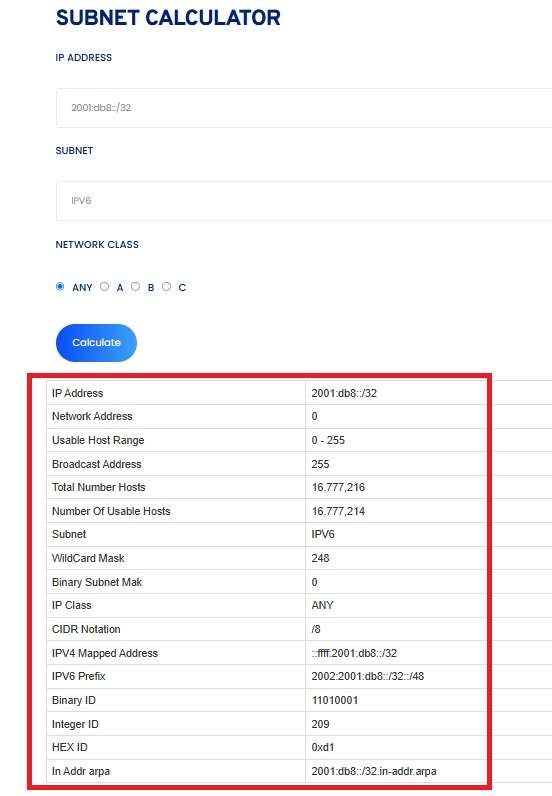
- Review Results: The calculator will display detailed results including subnet ranges, network addresses, and mor
Benefits of Subnet Calculator
A Subnet Calculator is a handy tool for network administrators, IT professionals, and students learning about networking. It helps you quickly divide a large IP network into smaller, manageable sub-networks (subnets).
One of the main benefits is saving time and reducing manual errors when calculating subnet masks, IP ranges, broadcast addresses, and host counts.
Using a subnet calculator makes network planning easier and more efficient. It helps optimize IP address usage, improves security by isolating segments, and enhances network performance.
Whether you're working with IPv4 or IPv6, this tool simplifies complex calculations into clear, easy-to-understand results.
It’s especially useful for designing networks, setting up routers, or managing large infrastructures.
Most subnet calculators are free and work online without the need to install anything. Overall, a subnet calculator is an essential tool for anyone managing or learning about computer networks.
Functionality
Our Subnet Calculator performs several critical functions:
- Subnet Mask Calculation: Determines the subnet mask based on the IP address and prefix length.
- Network Address Identification: Identifies the network address for each subnet.
- Broadcast Address Calculation: Calculates the broadcast address for communication within the subnet.
- Usable IP Range: Lists the range of IP addresses available for devices within the subnet.
- CIDR Notation: Converts traditional subnet masks into CIDR notation for flexibility.
Switches for Subnets
Switches play a crucial role in managing subnets within a network. Here’s a brief overview:
- Layer 2 Switches: Operate at the data link layer and can be used to manage traffic within a subnet.
- Layer 3 Switches: Function at the network layer and can route traffic between different subnets.
Understanding how switches interact with subnets helps in optimizing network performance and ensuring efficient data routing.
IPv6 Subnet Calculator
IPv6 subnetting is essential for modern networks due to the exhaustion of IPv4 addresses. Our IPv6 Subnet Calculator helps you manage IPv6 addresses effectively:
- Prefix Length: IPv6 uses prefix lengths (e.g., /64) to define subnet sizes.
- Address Allocation: Allows for efficient allocation of IPv6 addresses to various subnets.
With increasing IPv6 adoption, our tool is equipped to handle the complexities of IPv6 subnetting.
Subnet Calculator CIDR
Classless Inter-Domain Routing (CIDR) is a method used to allocate IP addresses more efficiently than traditional class-based systems. Our Subnet Calculator supports CIDR notation:
- Flexible Subnetting: CIDR allows for variable-length subnet masking, optimizing IP address usage.
- Simplified Management: Provides a more straightforward way to manage IP addresses compared to classful subnetting.
Subnetting Formula
The basic formula for subnetting is:
- Number of Subnets = 2^n, where n is the number of bits borrowed from the host part.
- Number of Hosts per Subnet = 2^(number of host bits) - 2 (subtracting 2 for network and broadcast addresses).
Using these formulas, our Subnet Calculator can quickly determine the number of subnets and hosts.
If you're exploring financial planning, check out our Step Up SIP Calculator to estimate your investment growth.
Example:
Example 1: IPv4 Subnetting
IP Address: 192.168.1.0
Subnet Mask: 255.255.255.0 (or /24)
Result:
Network Address: 192.168.1.0
Broadcast Address: 192.168.1.255
Usable IP Range: 192.168.1.1 to 192.168.1.254
Example 2: IPv6 Subnetting
IP Address: 2001:db8::/32
Prefix Length: /48
Result:
Network Address: 2001:db8::/48
Broadcast Address: Not applicable (IPv6 does not use broadcast addresses)
Usable IP Range: Defined by the /48 prefix
How to Calculate 24 Subnets?
To calculate 24 subnets, you need to apply subnetting techniques to an IP address block. Start with a Class C network (which has a default subnet mask of 255.255.255.0 or /24).
To create 24 subnets, determine how many bits you need to borrow from the host portion of the IP address.
Using the formula 2ⁿ ≥ required subnets, you’ll find that 5 bits are needed (2⁵ = 32 subnets).
By borrowing 5 bits from the host part, the new subnet mask becomes /29 (255.255.255.248). Each /29 subnet provides 8 IP addresses, with 6 usable for hosts.
This means you can create 32 subnets, but if you only need 24, you just use the first 24 subnet blocks.
Subnetting is crucial for efficient IP management and network segmentation, especially in enterprise and cloud-based environments. Use subnet calculators for faster and error-free results.
Applications of Subnet Calculator
A Subnet Calculator is an essential tool for network administrators and IT professionals, simplifying the process of dividing an IP address into smaller, manageable subnets.
One of its key applications is network design and optimization, allowing users to allocate IP addresses efficiently and avoid network congestion.
By calculating subnet masks, the tool helps in maximizing IP address usage, ensuring that every network device has a unique address while minimizing waste.
It is also valuable for troubleshooting network issues, as it helps administrators verify network configurations and ensure correct subnetting.
Additionally, a Subnet Calculator is useful when setting up virtual private networks (VPNs) or configuring routers and firewalls. It ensures that data packets are routed correctly across different subnets.
Overall, a Subnet Calculator simplifies complex tasks and enhances network performance, making it a must-have tool for anyone involved in network management or system administration.
While you're here, you can also use our Ideal Weight Calculator for your health-related calculations.
Advantages of Subnet Calculator
A Subnet Calculator offers several key advantages for network administrators and IT professionals. It simplifies the complex task of dividing IP networks into subnets by providing accurate calculations instantly.
This tool helps determine subnet masks, IP ranges, and the number of available hosts per subnet, making network planning more efficient and error-free.
One of the main benefits is its ability to reduce manual computation time and minimize human errors. It also enhances network security and performance by enabling better segmentation and control of IP address allocation.
Whether setting up a small office network or managing large enterprise systems, a subnet calculator ensures optimal use of IP space.
Additionally, it supports both IPv4 and IPv6 formats, making it versatile for modern networking needs.
Overall, a Subnet Calculator is an essential tool that improves accuracy, speeds up configuration, and supports scalable network management.
Conclusion of Subnet Calculator
In conclusion, a Subnet Calculator is a valuable tool for anyone involved in network design and management.
It streamlines the process of calculating subnets, IP ranges, and network classes, reducing the risk of errors and saving time.
By providing instant and accurate results, it allows IT professionals to efficiently plan and organize IP addresses for optimal performance and security.
Whether you are managing a home network or an enterprise-level infrastructure, a Subnet Calculator simplifies complex calculations and ensures efficient resource allocation.
Its support for both IPv4 and IPv6 makes it highly adaptable to current networking standards. Easy to use and highly effective, this tool is a must-have for building scalable and reliable networks.
Embracing a Subnet Calculator helps users focus more on strategy and less on manual computation, ultimately leading to smarter and more secure network solutions.
Frequently Asked Questions
Q1: What is the primary purpose of a subnet calculator?
Ans: A subnet calculator simplifies the process of subnetting by providing accurate calculations of network parameters based on the input IP address and subnet mask.
Q2: Can I use your subnet calculator for both IPv4 and IPv6 addresses?
Ans: Yes, our tool supports both IPv4 and IPv6 subnetting.
Q3: How does CIDR notation work in subnetting?
Ans: CIDR notation specifies the number of bits used for the network portion of the address, allowing for more flexible and efficient subnetting.
Q4: What is the difference between a subnet mask and CIDR notation?
Ans: A subnet mask is a traditional way of representing the network portion of an IP address, while CIDR notation uses a slash followed by the number of bits used for the network.
Q5: How accurate is the subnet calculator?
Ans: Our subnet calculator uses advanced algorithms to ensure high accuracy in all calculations.
Q6: Can I calculate multiple subnets at once?
Ans: Yes, the tool allows for calculations of various subnets based on the input parameters.
Q7: Is there a limit to the number of subnets I can calculate?
Ans: The number of subnets is determined by the network's address space and prefix length. Our tool can handle a wide range of scenarios.
Q8: What is the benefit of using IPv6 subnetting?
Ans: IPv6 provides a larger address space and improved routing efficiency compared to IPv4.
Q9: How can I visualize subnetting results?
Ans: Our calculator offers interactive visualizations to help you understand subnetting results better.
Q10: Can I use the subnet calculator for educational purposes?
Ans: The tool is designed to aid in learning and understanding subnetting concepts.
Q11: What are the common subnetting mistakes to avoid?
Ans: Common mistakes include using incorrect subnet masks, overlooking broadcast addresses, and miscalculating subnet ranges.
Q12: How do I handle subnetting in a large network?
Ans: Use hierarchical subnetting and our calculator to break down large networks into manageable subnets.
Q13: Is the subnet calculator free to use?
Ans: Yes, our Subnet Calculator is completely free to use on www.toolerz.com.
Q14: How often is the tool updated?
Ans: We regularly update the tool to ensure it meets the latest networking standards and user needs.
Q15: Can the tool handle custom subnetting scenarios?
Ans: Yes, the tool is flexible and can accommodate a variety of custom subnetting scenarios.
Q16: Why is a Subnet Calculator useful?
Ans: A Subnet Calculator is useful for:
Efficiently managing IP address allocation.
Reducing network congestion by dividing large networks.
Enhancing security by segmenting networks.
Simplifying network troubleshooting and maintenance.
Q17: Do I need technical knowledge to use a subnet calculator?
Ans: No advanced knowledge is required. Even beginners can use it easily by entering the IP address and selecting a few options. The tool handles all the complex math for you.
Q18: Is a subnet calculator only for IPv4?
Ans: Most tools support IPv4, but some also work with IPv6 addresses. Make sure to check if the calculator you're using supports the version you need.
Q19:Can a subnet calculator help with IPv6?
Ans: Yes, many subnet calculators support both IPv4 and IPv6. They can help you break large IPv6 address spaces into smaller, manageable subnets.
Q20: Who can benefit from a Subnet Calculator?
Ans: Network administrators, IT students, cybersecurity professionals, and anyone managing a network can benefit from using this tool.
Q21: What is a Subnet Calculator?
Ans: A Subnet Calculator is a tool that helps you divide a large network into smaller sub-networks. It shows important details like IP range, subnet mask, and number of hosts.