VOLUMETRIC WEIGHT CALCULATOR
What Is Volumetric Weight Calculator?
Calculating the correct weight and dimensions of a package is crucial in shipping & packing segment.
Volumetric weight calculator plays a vital role in this segment.
Volumetric weight is a pricing technique used by shipping companies. It takes into account the package's volume rather than just its actual weight.
This method ensures that the space a package occupies is factored into the shipping cost, which is particularly important for lightweight, bulky items.
Formula for Volumetric Weight:
Volumetric Weight= (LengthxWidthxHeight)/Divisor
The divisor can vary depending on the shipping company and mode of transport.
Benefits of Our Volumetric Weight Calculator
Accuracy: Our calculator provides correct results, ensuring you are charged correctly based on the volumetric weight.
User-Friendly Interface: Our easy to understand interface allows users to quickly input dimensions and get results.
Saves Time: Automates the calculation process, saving time for businesses and individuals.
Cost Efficiency: Helps users avoid unexpected shipping costs by understanding the true shipping weight.
functionality: Suitable for various industries, including e-commerce, logistics, and manufacturing.
How to Use Our Volumetric Weight Calculator
Using our volumetric weight calculator is very simple. Follow these steps if you are not aware of the procedure:
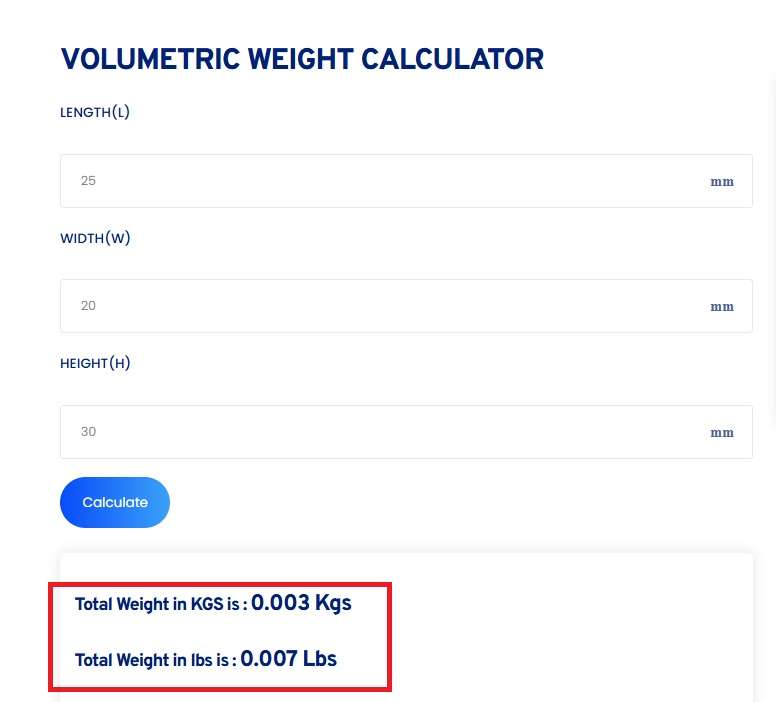
Enter Dimensions: Input the length, width, and height of the package in millimeters.
Select Divisor: Choose the appropriate divisor (5000 or 6000) based on the shipping company's requirements.
Calculate: Click the calculate button to get the volumetric weight.
Why Do We Divide by 5000 for Volumetric Weight?
The divisor 5000 is commonly used by shipping companies for air freight.
It’s based on the industry standard where one cubic meter of space is assumed to weigh 200 kilograms.
Formula Using Divisor 5000:
Volumetric Weight=(LengthxWeightxHeight)/5000
If you're planning to purchase a vehicle and need financial assistance, try our Car Loan Calculator to estimate your loan payments quickly.
Key Features of Volumetric Weight Calculator
A Volumetric Weight Calculator is a valuable tool designed to help users determine the dimensional weight of packages, especially in shipping and logistics.
One of its key features is the ability to calculate volumetric weight based on length, width, and height, using industry-standard formulas.
It ensures accurate cost estimation for couriers that charge by space occupied rather than actual weight. The tool supports multiple units (inches, cm, kg, lb) to suit global shipping needs.
Many calculators also include automatic unit conversion and user-friendly interfaces, allowing quick calculations with minimal effort.
Some advanced versions offer comparison tools to evaluate cost differences between actual and volumetric weight. This feature helps users choose the most cost-effective shipping method.
Whether you’re a business owner, logistics professional, or individual sender, the Volumetric Weight Calculator simplifies the shipping process, avoids overcharges, and ensures transparency in freight billing.
Why Divide by 6000 for Volumetric Weight?
The divisor 6000 is typically used for international air shipments. This divisor assumes a denser package weight per cubic meter.
Formula Using Divisor 6000:
Volumetric Weight=(LengthxWeightxHeight)/6000
Why Is Volumetric Weight Charged?
Volumetric weight is charged by shipping companies to account for the space a package takes up, not just its actual weight. This helps carriers use their storage space more efficiently, especially for large but lightweight items.
The formula to calculate volumetric weight is: (Length × Width × Height) ÷ Dimensional Factor If the volumetric weight is higher than the actual weight, the shipping cost is based on the larger number. For example, a big box filled with pillows may weigh little, but it takes up a lot of space—so it's charged by volume.
Charging by volumetric weight ensures fairness and better use of transportation capacity. It also encourages customers to pack more efficiently. Understanding this concept helps businesses and individuals plan shipments better, avoid extra fees, and choose the right packaging for cost-effective delivery.
How Do You Convert Kg to Volumetric Weight?
Converting actual weight to volumetric weight involves understanding that volumetric weight is typically larger for bulky items.
It’s about translating the physical space a package occupies into a weight metric that shipping companies use for pricing.
Example Conversion:
If a package measures 50 cm x 40 cm x 30 cm, its volume is:
50x40x30=60,000 cubic centimeters
Using a divisor of 5000: 60,000/5000 =12 kg
Examples of Volumetric Weight Calculation
Example 1: Small Package
Dimensions: 20 cm x 15 cm x 10 cm
Divisor: 5000
Calculation: 20×15×10/5000=0.6 kg
Example 2: Large Package
Dimensions: 100 cm x 50 cm x 40 cm
Divisor: 6000
Calculation: 100×50×40/6000=33.33 kg
Applications of Volumetric Weight Calculator
A Volumetric Weight Calculator is widely used in logistics and shipping to determine the chargeable weight of a package based on its size rather than actual weight.
One of its primary applications is in courier and freight services, where shipping costs are calculated based on dimensional weight to ensure fair pricing for large but lightweight items.
It’s also essential for eCommerce businesses, helping sellers estimate shipping charges accurately before dispatching products. Airlines and cargo companies use it to manage space optimization, ensuring cargo holds are filled efficiently.
Additionally, warehouse managers and packaging teams use volumetric weight calculators to plan storage space and packaging materials effectively.
With support for both metric and imperial units, it offers quick, accurate results for global shipping needs. Easy to use and accessible online, this tool simplifies logistics planning, saves costs, and improves operational efficiency across multiple industries.
If you're also tracking health-related milestones, check out our Conception Calculator to estimate key pregnancy dates.
Why Divide by 5000 for Volumetric Weight?
Volumetric weight is used in shipping to account for the space a package occupies, not just its actual weight. The formula to calculate volumetric weight is:
Volumetric Weight (kg) = (Length × Width × Height in cm) ÷ 5000
The divisor 5000 is a standard factor used by many courier services to convert volume (in cubic centimeters) into an equivalent weight. This helps carriers fairly charge for large but lightweight packages that take up more space in a delivery vehicle.
Using 5000 balances cost and capacity. If the divisor were smaller, prices would increase; if it were larger, carriers might lose money on bulky shipments. Some companies may use different divisors like 4000 or 6000, depending on shipping policies and regions.
In short, dividing by 5000 ensures that both size and weight are considered when determining shipping costs.
Advantages of Volumetric Weight Calculator
A Volumetric Weight Calculator offers significant advantages, especially in the shipping and logistics industry.
One of its main benefits is accurate cost estimation—by calculating the space a package occupies, it helps determine the correct shipping charges based on volumetric weight rather than just actual weight.
This prevents under- or overcharging, saving both shippers and customers from unexpected costs. It’s especially useful for lightweight but bulky items where dimensional weight is more relevant.
The tool is easy to use, supports multiple units of measurement, and provides instant results, making it efficient for businesses that manage high volumes of shipments.
It also helps optimize packaging by encouraging the use of space-efficient designs.
Whether you're an e-commerce seller, warehouse manager, or courier service, a Volumetric Weight Calculator streamlines shipping operations, ensures fair pricing, and enhances customer satisfaction through transparency and accuracy.
FAQs
Q1: What is volumetric weight?
Ans: Volumetric weight is a measurement used by shipping companies to calculate the cost of shipping based on the volume a package occupies rather than its actual weight.
Q2: Why do shipping companies use volumetric weight?
Ans: Shipping companies use volumetric weight to ensure they are remunerated fairly for the space a package occupies, especially for lightweight, bulky items.
Q3: How do I use the volumetric weight calculator?
Ans: Enter the package dimensions in centimeters, select the appropriate divisor, and click the calculate button to get the volumetric weight.www.toolerz.com
Q4: What is the difference between the 5000 and 6000 divisors?
Ans: The 5000 divisor is typically used for air freight within specific regions, while the 6000 divisor is used for international air shipments, reflecting different density assumptions.
Q5: How accurate is the volumetric weight calculator?
Ans: Our calculator is highly accurate, as long as you provide precise measurements of your package dimensions.
Q6: Can I use the volumetric weight calculator for sea freight?
Ans: Yes, the calculator can be used for sea freight, but you may need to check with your shipping company for the specific divisor they use.
Q7: Is the volumetric weight the same as the actual weight?
Ans: No, the volumetric weight is based on the package's dimensions, while the actual weight is the physical weight measured on a scale.
Q8: How do I know which divisor to use?
Ans: Check with your shipping company or service provider to determine the appropriate divisor for your shipment.
Q9: Can I calculate volumetric weight for multiple packages?
Ans: Yes, you can calculate the volumetric weight for each package individually or use the batch conversion feature if available.
Q10: Does this calculator support different units of measurement?
Ans: Our calculator primarily uses centimeters and kilograms, but it can be adapted to other units if necessary.
Q11: Why is volumetric weight important for e-commerce?
Ans: Volumetric weight helps e-commerce businesses accurately estimate shipping costs, which is crucial for pricing products and managing shipping expenses.
Q12: Can volumetric weight affect shipping cost?
Ans: Yes, especially for lightweight but bulky items. Using volumetric weight ensures that shipping costs reflect the space occupied rather than just the weight.
Q13: Can I use the calculator on my mobile device?
Ans: Absolutely! Many Volumetric Weight Calculators are mobile-friendly, which makes it easy to use them on smartphones and tablets when you’re on the go.
Q14: What is the formula for volumetric weight?
Ans:Volumetric weight is usually calculated as: (Length × Width × Height) / DIM factor The DIM factor (like 5000 or 6000) depends on the courier or shipping service. The calculator will use the right value for accurate results.
Q15: When is volumetric weight used instead of actual weight?
Ans: Shipping companies compare both actual weight and volumetric weight. They charge based on whichever is higher. This helps them manage space in delivery vehicles and airplanes.
Q16: Who should use a volumetric weight calculator?
Ans: It’s useful for online sellers, logistics companies, eCommerce businesses, and anyone shipping packages regularly. It helps plan shipping costs in advance.
Q17: What’s the difference between actual weight and volumetric weight?
Ans: Actual weight is how much a package physically weighs on a scale.
Volumetric weight is based on the size of the package — how much space it takes up.
Shipping companies charge whichever is higher, to make sure they’re not losing money on large, lightweight items.
Q18: Does volumetric weight apply to all shipping companies?
Ans: Most major shipping companies like FedEx, UPS, DHL, and others use volumetric weight to calculate shipping costs. Each company may use a different dimensional factor, so it's good to check their guidelines.