FACTOR CALCULATOR
What is Toolerz Factor Calculator?
Toolerz factor calculator is an online tool that helps users determine the factors of a given number. Factors are integers that can be multiplied together to produce the original number.
Let me explain this with the help of an example.
For example, the factors of 12 are 1, 2, 3, 4, 6, and 12 because:
1x12=12
2x6=12
3x4=12
How to Use Toolerz Factor Calculator?
You can manually calulate factors for small integers, but in case of large number it is very difficult to calculate manually. At that stage a brilliant tool like Toolerz will help you.
If you are unaware of how to use this tool, you can follow the below steps.
Step 1: Go to the Factor Calculator Page here
Step 2: Enter the value to get the integer factors & hit the calculate button. Go through the below image for your reference.
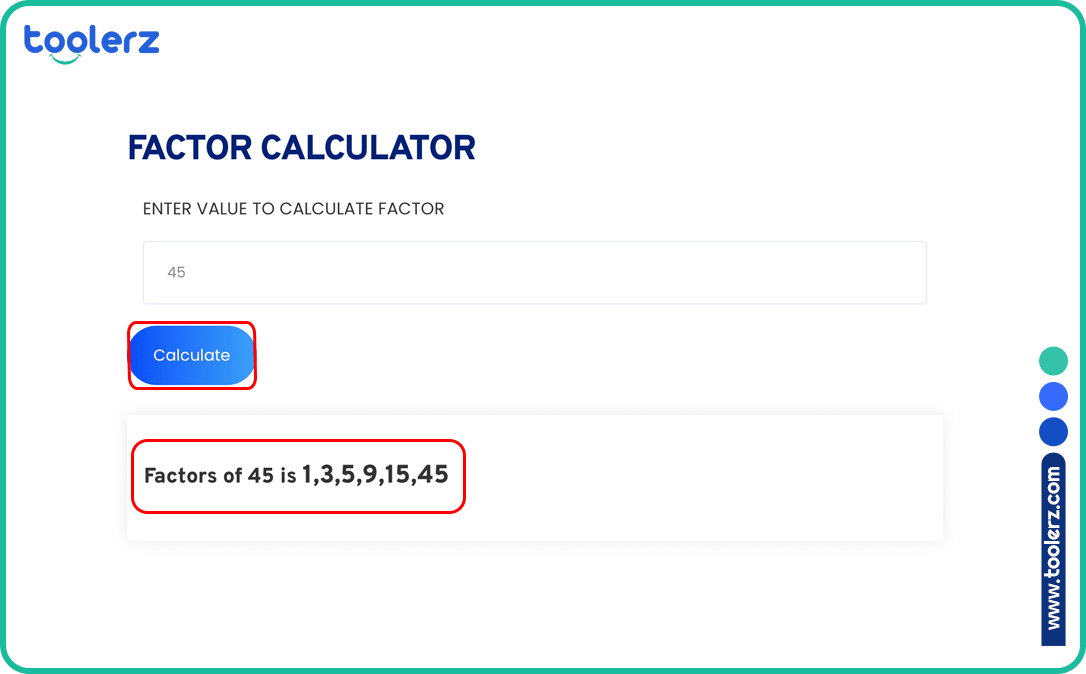
Step 3: All the possible integer factors are displayed on the screen.
Benefits of Using Toolerz Factor Calculator
More Accurate
Calculating Factors manually can be a stressful process and leads to errors, especially with larger numbers. Our factor calculator ensures accurate results without any mistakes.
Efficient than you Expect
Performing factorization manually can be time-consuming. A factor calculator like toolerz provides instant results, saves time and effort.
Easy to Use
Toolerz Factor calculator is a user-friendly tool, requires minimal input from the user. Simply enter the number, and the calculator will do the rest.
Versatility
Our calculator can handle various types of numbers, including integers, both positive and negative. This versatility makes suitable for a wide range of applications.
Helps Students
Factor calculators are valuable educational tools for students learning about factors and prime factorization. They provide immediate feedback, helping students understand the concept better.
For precise error calculations in measurements, check out our Percentage Error Calculator to determine the accuracy of your values.
Factor Calculator Formula
There are multiple ways of calculating factorization, the following are the respective formulas
Basic Factorization
The basic concept of factorization involves finding all pairs of numbers that multiply together to give the original number. If n is a given number, then a and b are factors of n if:
a×b=n
Prime Factorization
Prime factorization is nothing but breaking down a number into its prime factors. A prime number is a number greater than 1 that has no positive divisors other than 1 and itself. The formula for prime factorization of a number n is expressed as:

Examples of Using a Factor Calculator
Example 1: Basic Factorization
Calculate the factors of 28.
Solution:
The factors of 28 are: 1,2,4,7,14,28
Using our factor calculator, just enter the number 28, and it will list these factors instantly.
Example 2: Prime Factorization
Calculate the prime factorization of 60.
Solution: The prime factors of 60 are: 2,3,5
The prime factorization is: 60=2^2×3×5
Using our tool, just enter the number 60 into the factor calculator, and it will break it down into its prime factors.
How to Factor Numbers: Factorization
Factorization is the process of breaking down a number into a set of smaller numbers, called factors, that multiply together to give the original number. It's a basic but important math concept used in algebra, number theory, and everyday problem-solving.
To factor a number, start by dividing it by the smallest prime number (like 2, 3, or 5) and continue dividing until you can't go any further. For example, to factor 12:
12 ÷ 2 = 6
6 ÷ 2 = 3
3 ÷ 3 = 1
So, the prime factors of 12 are 2 × 2 × 3.
You can also list factor pairs, like 1 × 12, 2 × 6, and 3 × 4.
Factoring helps in simplifying equations, finding greatest common divisors (GCD), and solving fractions. Using a factor calculator can make the process quicker and easier, especially for large numbers.
What is the Common Factor Calculator?
A Common Factor Calculator is a handy online tool used to find the common factors (or divisors) of two or more numbers. A factor is a number that divides another number evenly, leaving no remainder.
When two numbers share the same factors, those are called common factors. For example, the common factors of 12 and 18 are 1, 2, 3, and 6.
This calculator saves time by quickly listing all shared factors without the need for manual division or factor trees.
It is especially useful for students, teachers, and anyone working with fractions, simplifying expressions, or solving math problems.
Using a Common Factor Calculator is easy—just input the numbers, and the tool does the rest. It's a great way to build a strong foundation in basic math and improve problem-solving skills efficiently.
Advantages of Factor Calculator
A Factor Calculator is a handy tool that helps users quickly find all the factors of a given number. One of its main advantages is time-saving and accuracy, especially when working with large numbers that are difficult to factor manually.
This tool is useful for students, teachers, and anyone involved in mathematics or number theory. It simplifies complex calculations by instantly listing both prime and whole number factors.
This makes it easier to understand number properties, solve equations, or work on problems involving greatest common divisors (GCD) or least common multiples (LCM).
Using a factor calculator also helps reduce manual errors and improves learning by offering quick and clear results.
Whether you’re preparing for exams or solving everyday math problems, this calculator enhances your efficiency and understanding.
If you're also looking for weight calculations in engineering, try our Pipe Weight Calculator for accurate results.
Key Features of Using Factor Calculator
A factor calculator is a handy tool that helps users quickly find all the factors of a given number. One of its key features is instant calculation, saving time and effort, especially for large numbers. It displays both positive and negative factors, ensuring complete results.
The calculator is often user-friendly with a simple input box—just enter a number and click a button to get the answer. Another helpful feature is the display of prime factors, which is useful for solving math problems, simplifying fractions, or checking divisibility.
Many factor calculators also support multiple inputs or batch processing, making them suitable for students, teachers, and professionals. Some tools may even show step-by-step breakdowns, enhancing learning and understanding.
Overall, a factor calculator improves accuracy, simplifies complex calculations, and is an essential math tool for educational and practical applications.
Applications of Using Factor Calculator
A factor calculator is a helpful tool for finding all the factors of a given number quickly and accurately. It is commonly used by students, teachers, and professionals to solve mathematical problems involving number theory, prime factorization, and divisibility. In schools, it supports learning by helping students understand how numbers can be broken down into their components.
In real-life applications, factor calculators are useful in fields like engineering and construction where measurements and materials need to be evenly distributed
. Financial analysts also use it when working with ratios and simplifying large numerical data.
It is also helpful when preparing for competitive exams that involve quick math problem-solving. By automating the process of finding factors, this tool saves time and improves accuracy.
Overall, a factor calculator simplifies complex math and supports faster, more efficient decision-making in both education and professional tasks.
Frequently Asked Questions (FAQs)
Q1. What is Toolerz Factor Calculator?
Ans: Toolerz factor calculator is a tool that determines the factors of a given number, simplifying the process of factorization. Use the tool here.
Q2. How do I use Toolerz Factor Calculator?
Ans: To use our factor calculator, enter the number you want to factorize. Our calculator will then list all the factors of that number.
Q3. Can Toolerz factor calculator handle negative numbers?
Ans: Yes, our factor calculator can handle both positive and negative integers, providing factors for negative numbers as well.
Q4. Is Toolerz factor calculator accurate?
Ans: Yes, our tool was designed to provide accurate results, minimizing the risk of human error in manual calculations.
Q5. Can I use Toolerz factor calculator for prime factorization?
Ans: Yes, our tool include prime factorization features, breaking down a number into its prime factors.
Q6. What are the applications of factor calculators?
Ans: Factor calculators are used in education, science, engineering, finance, computer science, and everyday life for various factorization tasks.
Q7. How do factor calculators benefit students?
Ans: Factor calculators provide immediate feedback, helping students understand factorization concepts, verify their work, and improve their problem-solving skills.
Q8. Can I use Toolerz factor calculator on my smartphone?
Ans: Yes, our factor calculator is mobile friendly, making it convenient to perform factorization on the go.
Q9. Are there any limitations to factor calculators?
Ans: While factor calculators are highly versatile, they may have limitations in handling extremely large numbers or complex mathematical expressions beyond standard factorization.
Q10. What is the difference between factors and prime factors?
Ans: Factors are numbers that can be multiplied together to produce the original number. Prime factors are the prime numbers that multiply together to give the original number.
Q11. Can a number have only two factors?
Ans: Yes! A number with only two factors (1 and itself) is called a prime number. Examples include 2, 3, 5, 7, 11, etc.
Q12. Can a factor calculator find prime factors too?
Ans: Yes, some factor calculators also show prime factors. These are the factors that are prime numbers, like 2, 3, 5, etc..
Q13. Is it free to use an online Factor Calculator?
Ans: Yes, most factor calculators online are free to use. You don’t need to sign up or download anything www.toolerz.com .
Q14. Why is a factor calculator useful?
Ans: It saves time and effort, especially when working with large numbers where finding factors by hand can be slow and hard.
Q15.What is the difference between factors and multiples?
Ans: Factors divide a number evenly. Multiples are the results of multiplying a number by other whole numbers. For example, factors of 6 are 1, 2, 3, 6. Multiples of 6 are 6, 12, 18, etc.
Q16.Do I need math skills to use a factor calculator?
Ans: Not at all! Just type in the number, and the tool does the rest.